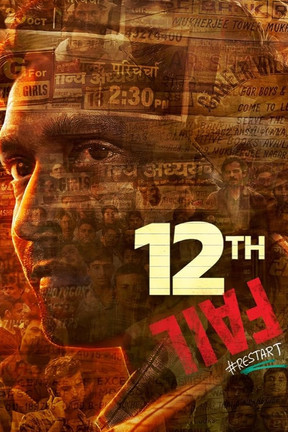
The Gentle Art of RestartingIn an era of Indian cinema dominated by hyper-masculine saviors and spectacle-driven universes, Vidhu Vinod Chopra’s *12th Fail* arrives as a quiet, subversive whisper. It is a film that dares to suggest that the greatest battles are not fought with fists in slow motion, but in the cramping hand of a student writing under a flickering streetlamp. Chopra, a veteran director often associated with the polished grandeur of *1942: A Love Story* or the gritty stylized violence of *Parinda*, here strips away the varnish to reveal something achingly raw. *12th Fail* is not merely a biopic of IPS officer Manoj Kumar Sharma; it is a humanistic study of the Indian dream—a dream that is as suffocating as it is liberating.

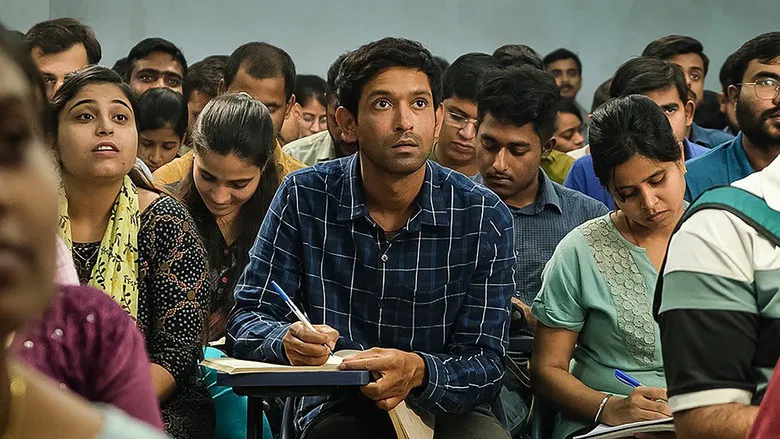
The film’s visual language is a masterclass in claustrophobia and release. Chopra, alongside cinematographer Rangarajan Ramabadran, captures the geography of desperation with an unblinking lens. The camera dwells on the grime of a flour mill where Manoj (Vikrant Massey) sleeps and works, the cramped cubicles of Mukherjee Nagar, and the sea of faces in coaching centers. These spaces are not sets; they feel like prisons of aspiration. Yet, the film breathes during its moments of silence—a shared cup of tea, a glance across a library desk. The darkness of the flour mill is constantly juxtaposed with the blinding, almost sterile light of the interview rooms, creating a visual metaphor for the protagonist's journey from the shadows of Chambal to the scrutiny of the civil services.
At the center of this narrative whirlwind is Vikrant Massey, who delivers a performance of shattering vulnerability. As Manoj, Massey does not play a hero; he plays a survivor. His physical transformation—darkening into a sun-burnt, malnutritioned shadow of himself—is effective, but it is his eyes that carry the film. They hold a terrifying mixture of fear and hope that anyone who has ever gambled their life on a single exam will instantly recognize.
The heart of the film, however, lies in its refusal to romanticize poverty. Unlike the "poverty porn" that often plagues Western depictions of India, *12th Fail* treats hardship with dignity. The struggle is not the point; the *response* to the struggle is. This is best exemplified in the relationship between Manoj and Shraddha (Medha Shankr). Their romance is not a distraction from the plot but the emotional fuel that powers it. In a landscape where cinematic love often feels transactional or obstacle-ridden, their bond is a quiet pact of mutual respect. Shraddha is not a trophy at the finish line; she is the pacer in the marathon.
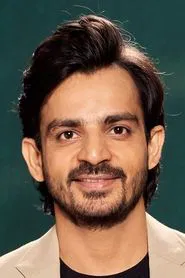
One cannot discuss *12th Fail* without addressing the concept of "Restart." It is a mantra that echoes through the narrative, delivered with memorable gravitas by Anshumaan Pushkar’s character, Gauri Bhaiya. Gauri serves as the tragic anchor of the story—the one who didn't make it, the ghost of failures past who guides Manoj so he doesn't suffer the same fate. This dynamic elevates the film from a simple success story to a commentary on the collective trauma of the Indian education system. It acknowledges that for every Manoj who succeeds, there are thousands of Gauris who dissolve into the background, their brilliance unrewarded.

Ultimately, *12th Fail* is a triumph of empathy. It rejects the cynicism that has seeped into modern storytelling, choosing instead to believe in the unfashionable virtues of honesty and grit. It does not shy away from the corruption of the system, but it argues that integrity is a personal revolution. In a cinematic landscape crowded with noise, Vidhu Vinod Chopra has crafted a film that listens—to the heartbeat of the underdog, to the silence of the library, and to the enduring power of starting over.