The Echo of a Laugh That No Longer Belongs to UsThere is a peculiar melancholy in watching a comedian wrestle with his own ghost. In *Manitou’s Canoe* (*Das Kanu des Manitu*), Michael "Bully" Herbig returns to the dusty, saturated plains of his greatest triumph not as a conqueror, but as a man trying to prove he still knows the way home. Arriving twenty-four years after *Manitou’s Shoe* redefined the commercial possibilities of German cinema, this sequel is less a continuation of a story and more a litigation of its own existence. It is a film that desperately wants to be a carefree reunion tour but cannot escape the cultural noise that now surrounds it.
Herbig, directing with his usual technical polish, attempts to navigate a minefield of modern sensibilities with the same map he used in 2001. The visual language is undeniably impressive; the wide shots of the Spanish Almería deserts (doubling for the American West) are lush and cinematic, evoking the classic Karl May adaptations of the 1960s with a loving, almost fanatical precision. The film looks expensive, bathed in the golden hour of a genre that has long since set. Yet, this beauty often feels like a high-gloss varnish applied to a structure that is creaking under the weight of time.
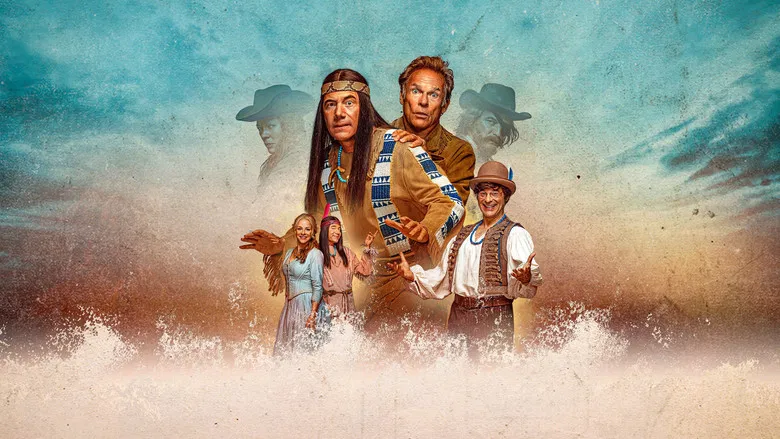
The narrative premise—Abahachi (Herbig) and Ranger (Christian Tramitz) lured into a trap involving the titular canoe—is thin, serving mostly as a clothesline on which to hang a series of sketches. But the film’s true conflict isn’t between the blood brothers and the resurrected villain Santa Maria; it is between the film’s desire to offend and its need to be loved. Herbig explicitly stated that the modern discourse on cultural appropriation inspired him to return, yet the result is a strange exercise in self-consciousness.
We see this tension in the script's meta-commentary. Abahachi corrects people for calling him an "Indian," a nod to the linguistic shifts of the last two decades. However, these moments often play less like genuine satire and more like a shield—a way for the film to say, "I know the rules," before proceeding to break them with the same broad, caricature-heavy humor of the early millennium. The return of the flamboyantly gay Winnetouch and the Greek Dimitri (Rick Kavanian) feels less like a celebration of beloved characters and more like a defiance of changing tides. It is nostalgia weaponized as a defense mechanism.
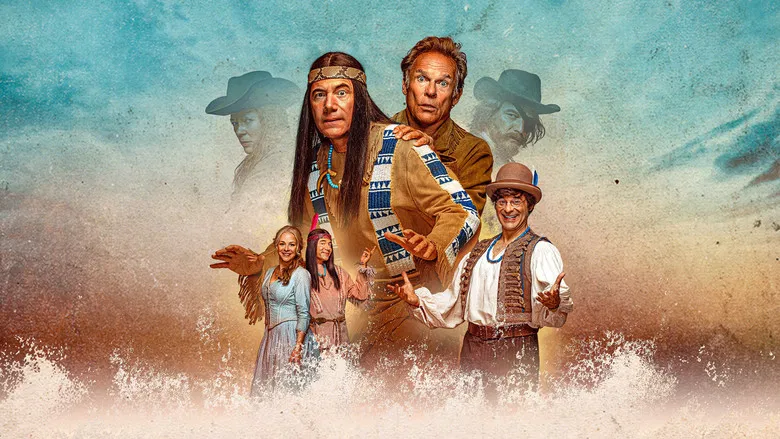
The heart of the film, if one can be found amidst the barrage of slapstick and fourth-wall breaks, lies in the chemistry between Herbig, Tramitz, and Kavanian. There is a palpable warmth when the trio is on screen, a rhythm born of decades of collaboration. In their eyes, you see a flicker of the anarchic joy that powered the *Bullyparade* sketch show. But that joy is fleeting. The laughter they generate is the laughter of recognition, not revelation. We laugh because we remember laughing before, not because the joke has revealed a new truth about the human condition or the absurdity of the Western myth.
Ultimately, *Manitou’s Canoe* floats in a strange limbo. It is too polished to be a simple cash-grab, yet too defensive to be true art. It tries to hold two opposing ideas: that nothing has changed, and that everything has changed. For the audience that grew up with the original, it offers a comforting, if slightly stale, embrace. But for cinema itself, it serves as a reminder that while you can rebuild the sets and rehire the actors, you cannot recreate the innocence of a bygone era. The canoe is water-tight, but the river has run dry.