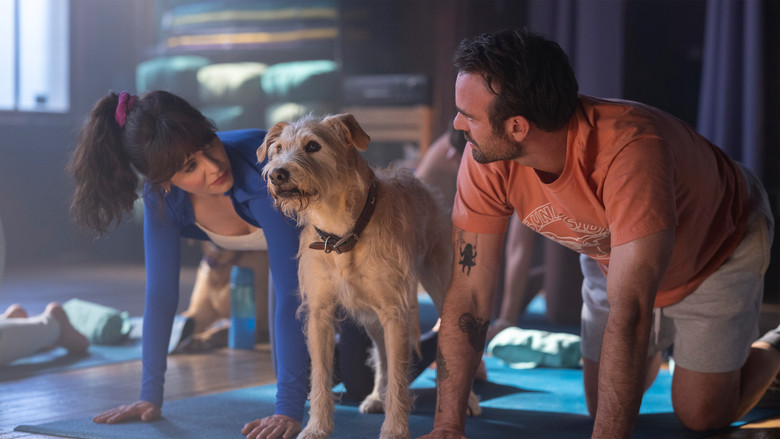
The Weight of a WagThere is a moment in Jessica Swale’s *Merv* where the camera lingers not on the dewy eyes of Zooey Deschanel, nor on the furrowed, charmingly British brow of Charlie Cox, but on the slumped posture of a terrier mix named Gus. It is a shot that encapsulates the film's peculiar ambition: to locate the profound silence of human grief within the non-verbal sadness of a canine. The film, a holiday rom-com released amidst the streamer deluge of December 2025, attempts to elevate the "pet custody" trope into a meditation on how we use innocent bystanders—in this case, a four-legged one—as proxies for our own unresolved trauma. That it succeeds only sporadically is a testament to the difficulty of balancing screwball antics with the heavier emotional luggage Swale attempts to unpack.

Swale, a director whose background lies in the rich, text-heavy world of British theatre (*Blue Stockings*, *Nell Gwynn*) and the period tenderness of her debut film *Summerland*, brings a distinct visual stillness to a genre usually defined by kinetic chaos. The film’s aesthetic is surprisingly muted for a holiday comedy; the Boston interiors are cramped and shadowed, reflecting the claustrophobia of Anna (Deschanel) and Russ’s (Cox) post-breakup purgatory. When the narrative shifts to the sun-bleached dog resort in Florida, the brightness feels almost abrasive, a visual metaphor for the forced cheerfulness the protagonists are trying to impose on their depressed pet. Swale uses the dog not just as a prop, but as a silent chorus—Merv’s lethargy is the physical manifestation of the words Anna and Russ refuse to say.
However, the film struggles to reconcile its visual literacy with a script that often retreats into safety. We are presented with a premise that demands high emotional stakes—Anna’s infertility is revealed as the silent wedge that drove the couple apart—yet the dialogue frequently reverts to the snappy, harmless rhythms of a sitcom. Deschanel, an actress of immense specific charm, is occasionally stranded in scenes that require her to be "quirky" rather than devastated. Conversely, Cox brings a grounded, almost weary gravity to Russ, a man who realizes that "sharing custody" is just a masochistic way of delaying a funeral for the relationship. The clash between these performance styles creates a friction that is sometimes productive, but often distracting.
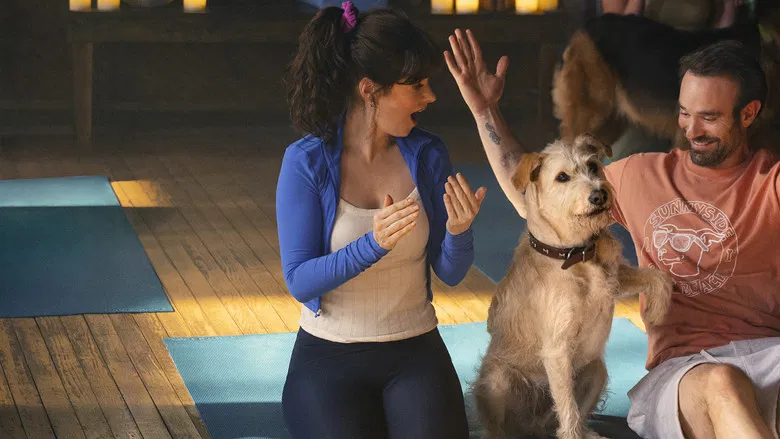
The "conversation" surrounding *Merv* has largely focused on its safety—critics have dismissed it as "saccharine" or "formulaic." Yet, to dismiss it entirely is to miss the subversive nature of its third act. The "break-up within the make-up" sequence, where Russ attempts to give Merv to Anna permanently to break their cycle of pain, offers a surprising maturity. It acknowledges that love, in its most adult form, sometimes requires a clean break rather than a messy tether. It is here that Swale’s theatrical roots show; she allows the scene to breathe, stripping away the holiday glitz to let two people simply hurt in a room. It is a brief flash of the film that *Merv* could have been—a *Blue Valentine* for the dog park set.
Ultimately, *Merv* occupies a strange middle ground in the modern cinematic landscape. It is too heavy to be pure escapism, yet too glossy to be a true indie drama. It serves as a reminder that the rom-com genre is currently in an identity crisis, torn between the comforting tropes of the past and a desire for more "authentic" modern storytelling. *Merv* may not fully resolve this tension, but in its quietest moments—watching a dog wait by a door that won't open—it touches on a universal truth about loyalty and loss that lingers longer than the forced happy ending.