The Geometry of DesireIf cinema is a mirror, Roger Kumble’s *Love Me Love Me* is a compact vanity mirror—glossy, well-lit, and utterly obsessed with surface reflections. Kumble, who once defined a generation’s cynical sexuality with *Cruel Intentions* and later steered the *After* franchise into the shoals of soft-core melodrama, returns here to his comfort zone. He treats the architecture of Young Adult romance not as a story to be told, but as a ritual to be performed. The film does not ask us to believe in its reality; it asks us to submit to its aesthetic.

Based on the viral Wattpad tetralogy by Stefania S., the narrative follows the genre’s strict liturgical calendar. June (Mia Jenkins), escaping the shadow of her brother’s death, arrives in Milan—a city Kumble shoots less as a geographical location and more as a high-fashion purgatory. She is immediately triangulated between Will (Luca Melucci), the golden-boy honor student who offers safety, and James (Pepe Barroso), the brooding "bully" with a sideline in clandestine MMA fighting.
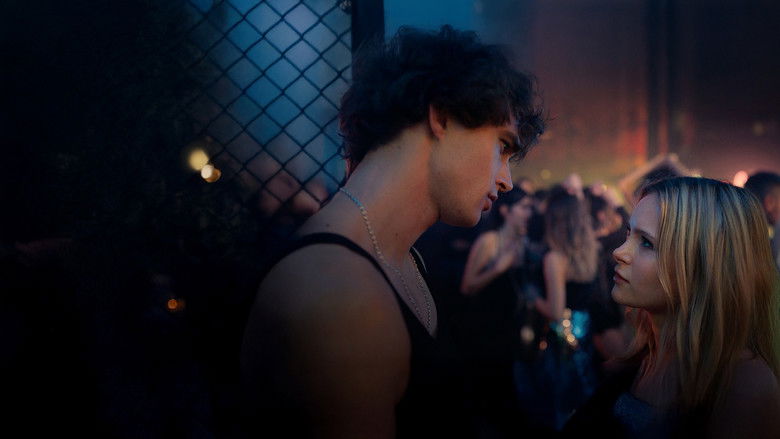
Kumble’s visual language here is suffocatingly precise. He favors a high-contrast gloss that renders the characters almost synthetic, emphasizing their role as archetypes rather than people. The underground fight scenes are bathed in neon and shadow, a deliberate visual counterpoint to the sterile, sun-drenched corridors of the elite international school. It’s a binary world: light versus dark, safety versus danger, the head versus the body.
However, the film struggles under the weight of its own solemnity. Where *Cruel Intentions* possessed a wicked, self-aware bite, *Love Me Love Me* plays its melodrama with a straight face that borders on the operatic. The script attempts to ground the teenage angst in the trauma of grief, but often confuses intensity for depth.
Yet, there is a pulse here, largely thanks to the chemistry between Jenkins and Barroso. In the film’s quieter moments—stripped of the MMA brutality and the heavy-handed dialogue about "secrets"—the actors manage to convey the terrifying confusion of first love. Jenkins, in particular, does heavy lifting to make June’s attraction to toxicity feel like a psychological response to loss rather than just a plot mechanic. She plays June not as a victim of the bad boy’s charm, but as someone seeking a pain she can control to replace the grief she cannot.

Ultimately, *Love Me Love Me* is a film about the lies we tell ourselves to survive adolescence. It is a glossy, heightened fever dream that will likely alienate critics looking for realism while perfectly satisfying an audience that craves emotional absolutism. Kumble proves once again that he is the auteur of the hormone-addled gaze, crafting a world where every glance is a weapon and every kiss is a catastrophe. It isn't deep, but like a bruise, it demands to be touched.