The Void in the Valentino SuitIt is one of cinema’s most potent ironies that Patrick Bateman has survived the last two decades not merely as a villain, but as a distorted meme of aspiration. A certain corner of the internet has reclaimed Christian Bale’s character as the "Sigma Male"—a stoic, successful archetype to be emulated. To view *American Psycho* through this lens is to fundamentally misunderstand the joke. Director Mary Harron, adapting Bret Easton Ellis’s controversial novel, did not craft a film about a powerful predator. She crafted a biting, feminist satire about a pathetic conformist, a man so terrified of his own irrelevance that he must carve his identity out of other people's flesh.

The brilliance of Harron’s direction lies in her visual translation of 1980s materialism. She shoots the film not with the shadowed grit of a slasher, but with the high-key lighting and sterile precision of a luxury skincare commercial. The camera glides over designer suits, nouvelle cuisine, and stainless steel surfaces with a fetishistic gaze, treating the humans in the frame with the same detached appreciation as the furniture. This visual language creates a suffocating reality where "surface" is the only depth that exists. When Bateman peels off his herb-mint facial mask in the opening sequence, he isn’t revealing his true face; he is simply removing one layer of artifice to reveal another, more permanent mask underneath.

This obsession with surface culminates in the film’s most celebrated sequence: the business card exchange. In a genre traditionally defined by jump scares, Harron finds true horror in a boardroom silence. As the Vice Presidents compare near-identical cards—obsessing over "Bone" versus "Eggshell" white, or the subtle thickness of the cardstock—we witness the fragility of Bateman’s ego. Bale’s performance here is a masterclass in micro-acting; his sweat creates a sheen of panic that betrays his composed exterior. The scene is hilarious, yes, but it is also a crushing depiction of the terror of conformity. In a world where everyone looks the same, talks the same, and desires the same things, the slightest deviation in a font choice feels like an existential threat.
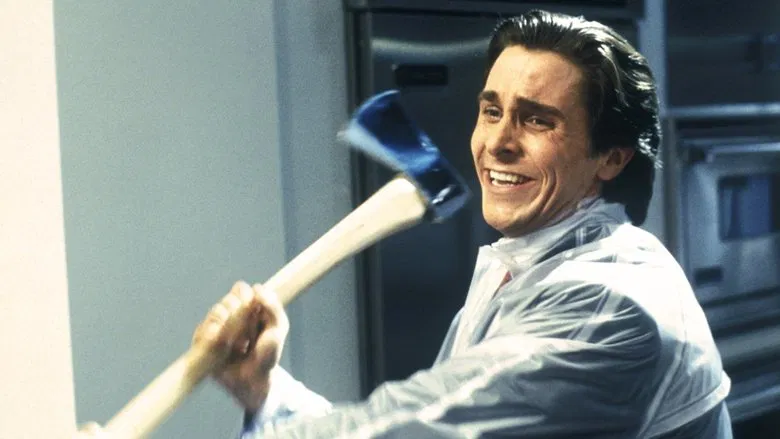
Ultimately, *American Psycho* is a tragedy of recognition. Bateman’s central struggle is not that he is a monster trying to hide, but that he is a monster screaming to be seen, yet no one is listening. His confession to his lawyer in the film's final act is dismissed not because it is unbelievable, but because in his social circle, people are interchangeable commodities. Whether the murders were hallucinations or reality is almost secondary to the film's grim conclusion: in a society entirely completely desensitized by greed and vanity, there are no consequences. There is no catharsis, no punishment, and as Bateman notes in his closing monologue, "this confession has meant nothing." The horror is not that the wolf is at the door, but that the sheep are too self-absorbed to notice they are being eaten.