The Weight of TinselThere is a specific, melancholic texture to the holiday film that often goes unremarked upon—a desperate, almost feverish insistence on joy that barely conceals the fractures beneath. In *A Merry Little Ex-Mas* (2025), director Steve Carr, a filmmaker who has long operated in the utilitarian trenches of studio comedy, attempts to mine this dissonance. He presents us with a world that is aggressively, relentlessly festive, yet populated by people who are fundamentally displacing their grief. While the film packages itself as a rom-com about "conscious uncoupling," it occasionally stumbles into a more interesting, if accidental, meditation on the performative nature of family traditions when the family itself has ceased to function.

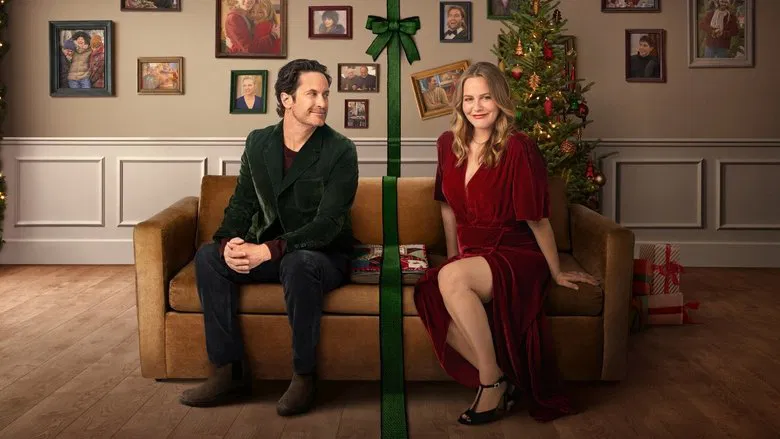
Visually, Carr and cinematographer Adam Santelli construct the fictional town of Winterlight not as a place, but as a suffocating blanket of comfort. The production design is less about realism and more about the tyranny of the aesthetic; every frame is stuffed with an excess of reds, golds, and twinkling lights that feel less like decoration and more like insulation against the cold reality of divorce. The camera frequently traps Kate (Alicia Silverstone) in these spaces—kitchens overflowing with poinsettias, living rooms crowded with memories—emphasizing how the domestic sphere, once her sanctuary, has become a museum of her failed marriage. It is a glossy, high-saturation prison, beautiful to look at but stifling to inhabit.
The heart of the film, and perhaps its saving grace, lies in Alicia Silverstone’s performance. There is a fragility to her Kate that transcends the script’s sitcom machinations. Silverstone, an actress who carries the kinetic memory of 90s stardom, plays Kate not as a scorned woman, but as someone exhausted by the labor of maintaining a facade. Her interactions with her estranged husband Everett (Oliver Hudson) are laced with a weary familiarity that feels painfully authentic. When Everett introduces his new, younger girlfriend Tess (Jameela Jamil), the film threatens to descend into lazy tropes of jealousy. Instead, Jamil plays Tess with a disarming, hyper-competent kindness that denies Kate the easy outlet of anger. This dynamic forces Kate—and the audience—to confront the uncomfortable truth that the "other woman" isn't the villain; the villain is simply the passage of time and the slow erosion of shared dreams.

However, the narrative creates a jarring tonal friction when it introduces Chet (Pierson Fodé), the younger handyman Kate dates in retaliation. While Fodé brings a requisite physical charisma, his presence tilts the film into broad farce that undermines the quieter, sadder story trying to breathe. The scenes involving the "chaotic" Christmas tree mishap or the performative jealousy at the town festival feel like concessions to a studio mandate for hijinks, disrupting the film's more tender exploration of what it means to let go. We are asked to laugh at the absurdity of the situation, but the laughter feels hollow compared to the moments of quiet realization on Silverstone's face—the realization that her architecture career was the price she paid for a life that is now dissolving.
Ultimately, *A Merry Little Ex-Mas* is a film at war with itself. It wants to be a comforting mug of cocoa, but the milk is slightly sour. It gestures toward a mature understanding of divorce—that love can mutate rather than disappear—but retreats into a conventional resolution that feels unearned given the emotional stakes established in the first act. It serves as a reminder that in the landscape of modern streaming cinema, the most radical act would be to let a sad story stay sad, rather than burying it under a mountain of tinsel. Carr delivers a competent diversion, but one leaves the viewing experience feeling that the most compelling version of this story happened in the silences between the dialogue, where the lights were off and the snow was just snow, cold and indifferent.