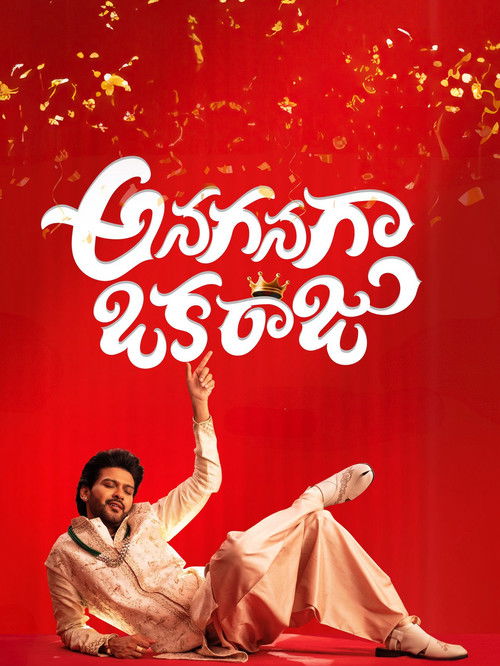
The Court Jester of Empty CastlesIf cinema is a mirror to society, then *Anaganaga Oka Raju* reflects a very specific, contemporary anxiety: the desperate performance of success in an economy of smoke and mirrors. Directed by Maari, who took the reins after a publicized directorial shift, the film arrives not merely as a Sankranthi festive vehicle but as a study of entitlement. It is a loud, colorful, and often hilarious dismantling of the "fake it till you make it" ethos that permeates modern hustle culture, anchored by a lead performance that is as exhausting as it is brilliant.

Visually, Maari constructs a world that feels intentionally like a stage set. The fictional village of Peddapalem is bathed in the over-saturated golden hues typical of Telugu commercial cinema, yet there is a subtle irony in the framing. The camera often lingers just a second too long on the crumbling architecture of Raju’s ancestral home—a visual metaphor for his hollow lineage. We see the grandeur, but we also see the peeling paint. This is not just poor maintenance; it is the visual language of decay dressed up as heritage. The cinematography by J. Yuvraj captures the vibrant chaos of the countryside, but often isolates Raju (Naveen Polishetty) in wide shots, emphasizing his smallness against the massive lies he constructs.
At the heart of this farce is Raju, played with manic, kinetic energy by Polishetty. Raju is a descendant of a Zamindar family who has inherited the ego but not the estate. He is a grotesque of the modern "influencer" mindset transferred to a rural setting—obsessed with optics, allergic to labor, and convinced that the world owes him a living. Polishetty does not play Raju as a misunderstood hero; he plays him as a charming narcissist. The "conversation" around this film often centers on Naveen’s improv-heavy style, but what is more fascinating is the underlying desperation he infuses into the comedy. His laughter is too loud; his swagger is too practiced. When he executes "Operation Charulatha" to woo the wealthy heroine (Meenakshi Chaudhary), it plays less like a romance and more like a heist.
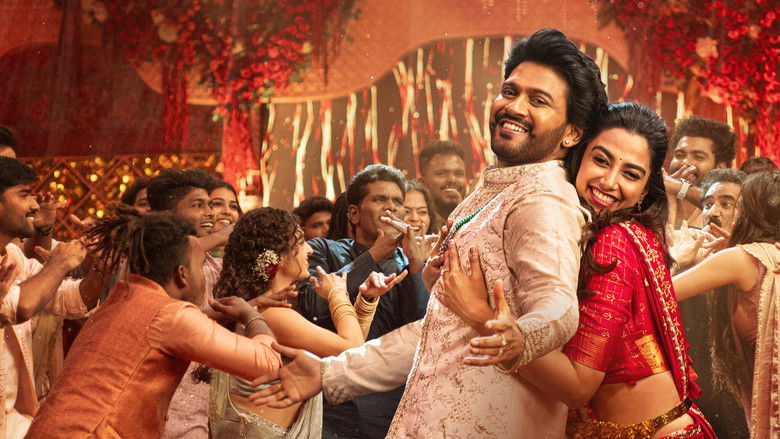
The film’s narrative fulcrum—the twist regarding Charulatha’s own financial reality—shifts the genre from a rom-com to a satire on shared delusion. While the second half suffers from pacing issues and a somewhat clumsy pivot to social responsibility and local politics, the chemistry between the leads keeps the film afloat. Meenakshi Chaudhary brings a grounded, quiet cunning that balances Polishetty’s noise. She is not merely a prize to be won but a mirror reflecting Raju’s own avarice back at him.
Ultimately, *Anaganaga Oka Raju* is a comedy of errors that accidentally stumbles into profound truth. It exposes the fragility of the "easy life" fantasy. While the script occasionally buckles under the weight of its own gags, and the resolution feels safer than the setup, the film succeeds as a character study. It suggests that in a world where everyone is pretending to be a king, the only true radical act is admitting you are a jester with empty pockets. It is an imperfect, uneven film, but one that laughs loudly to keep from screaming.