The Weight of Winter’s SilenceIt is a rare thing for a franchise built on the chaotic, candy-colored efficiency of rescue missions to pause and breathe in the cold air. *A Paw Patrol Christmas* (2025) arrives not merely as another merchandisable extension of the Spin Master juggernaut, but as a surprisingly meditative return to form for director Jamie Whitney. Having helmed the series’ earliest episodes, Whitney understands the foundational DNA of Adventure Bay better than anyone. But here, he strips away the hyper-kinetic "deploy and destroy" pacing of recent theatrical outings to ask a question that feels almost radical for preschool cinema: What happens when the machinery of giving breaks down?

Visually, the film is a departure from the neon-soaked vibrancy of *The Mighty Movie*. Whitney and his team have opted for a softer, more tactile palette. The snow in Adventure Bay doesn’t just look like white noise; it has weight and texture, muffling the usually boisterous sound design. There is a specific scene early in the film where Rubble (voiced with heartbreaking earnestness by Lucien Duncan-Reid) stands alone at the edge of town, staring up at the Northern Lights. The camera lingers on his small, bulldog frame against the vast, indifferent sky. It is a moment of profound isolation that recalls the quiet melancholy of *A Charlie Brown Christmas*, suggesting that even in a world of high-tech gadgetry, the anxiety of the holiday season is a universal, internal burden.
The narrative spine is deceptively simple: Santa has fallen ill, and the logistical chain of Christmas is severed. However, the film avoids the trap of simply replacing Santa with Ryder’s technology. Instead, the script pivots to a character study of Rubble. His desire for a "laser drill" is framed not as greed, but as a desperate need for validation through utility—he wants the tool to be a better helper, yet he fails to see that his presence is enough. Mayor Humdinger, usually a caricature of incompetence, is rendered here with a sharper edge. His plan to hijack the North Pole is driven by a pathetic loneliness, mirroring Rubble’s own insecurities. The conflict isn't just about saving presents; it’s about two characters trying to fill a void in their souls with material accumulation.
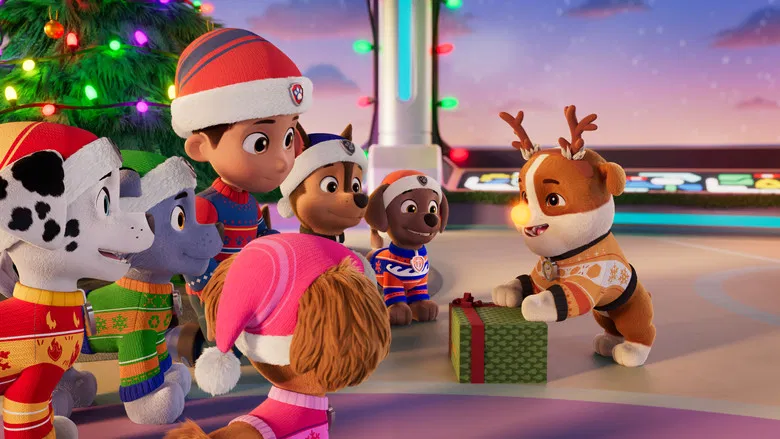
The climax, involving a perilous traverse across the ice to Santa’s workshop, is a masterclass in tension. Whitney uses the vast whiteness of the arctic setting to dwarf the pups, emphasizing their vulnerability. We are so used to seeing them in their invincible vehicles that seeing them slip, struggle, and shiver on the ice creates a genuine sense of stakes. The "rescue" here is physical, yes, but the true salvation occurs in a quiet dialogue scene between Rubble and Santa. The realization that Christmas persists without the perfect gift—or indeed, without any gifts at all—is delivered without the usual saccharine sermonizing. It feels earned.

Ultimately, *A Paw Patrol Christmas* transcends its commercial mandate. It rejects the noise of modern "content" for a story about the silence of a winter night and the warmth required to break it. By focusing on the emotional labor of the holiday rather than the mechanical execution of it, Jamie Whitney has crafted a film that respects the intelligence of its young audience. It serves as a gentle reminder that while the pups may save the world with jetpacks and grappling hooks, they save each other with empathy.