The Peter Pan of the ApocalypseIf Ridley Scott’s original *Alien* was a haunted house movie in space, and James Cameron’s *Aliens* was a Vietnam War allegory, Noah Hawley’s *Alien: Earth* is something far stranger: a twisted bedtime story about children who refuse to grow up, set against the backdrop of a dying world. Hawley, the mind who turned the Coen Brothers’ *Fargo* into a sprawling Midwestern epic and fractured the superhero genre with *Legion*, has finally brought the Xenomorph home. The result is a series that is less interested in the mechanics of jump scares than in the terrifying implications of creating life only to enslave it.
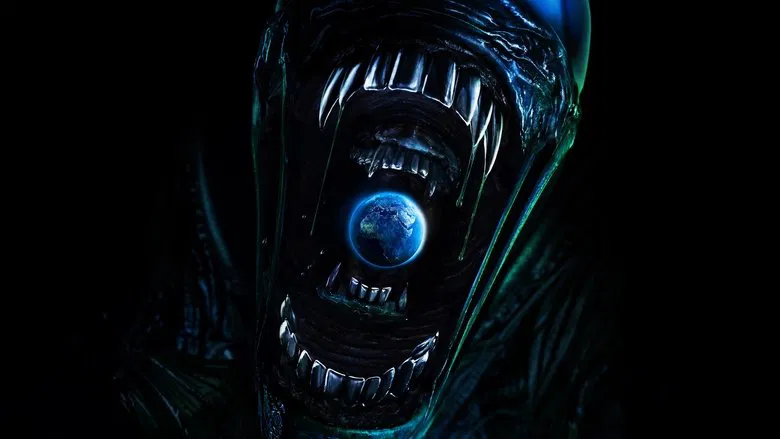
The year is 2120, two years before the events of the original film. The setting is not the cold vacuum of space, but a lush, suffocating Earth dominated by corporate fiefdoms. When the USCSS *Maginot* crash-lands, unleashing the "perfect organism" onto our soil, it feels less like an invasion and more like a reckoning. But the true horror of *Alien: Earth* isn't just the acid-blooded star-beast; it is the "hybrids"—synthetic bodies housing the consciousnesses of terminally ill children. Led by Wendy (a transfixing Sydney Chandler), these "Lost Boys" are the show’s beating heart. They are innocent minds trapped in weapons of war, a literalization of how the future devours the young to sustain the egos of the old.
Visually, Hawley eschews the clean, Apple-store aesthetic of Scott’s prequels (*Prometheus*, *Covenant*) for a tactile, sweaty "retro-futurism" that feels consistent with the 1979 original. The technology is clunky, the monitors flicker with green analog text, and the atmosphere is thick with dread. Hawley understands that the Xenomorph is scariest when it is obscured—a shadow in the tall grass, a silhouette against lightning. The cinematography, often low-to-the-ground and claustrophobic, forces us to adopt the perspective of the prey.

However, the show’s ambition is also its heaviest burden. By introducing the Peter Pan allegory—with the petulant trillionaire Boy Kavalier (Samuel Blenkin) playing a sadistic Peter to Wendy’s reluctant mother figure—Hawley risks over-intellectualizing a franchise built on primal fear. There are moments where the metaphor screams louder than the monsters. Yet, it is impossible not to be moved by the central tragedy of Wendy. Chandler plays her not as a Ripley clone, but as a confused child navigating a god-like body, oscillating between terrifying violence and heartbreaking vulnerability. Her realization that the adults in the room—the corporate overlords chasing immortality—are more parasitic than the facehuggers is the season's most chilling revelation.

Ultimately, *Alien: Earth* succeeds because it refuses to just play the hits. It doesn't simply offer us another bug hunt; it asks what happens when the monster isn't the invader, but the legacy we leave behind. The finale, with its shifting power dynamics and Wendy's chilling declaration of "Now, we rule," suggests that the greatest threat to humanity was never the alien. It was our own refusal to let nature take its course. In Hawley’s hands, the Xenomorph is no longer just a predator; it is the inevitable end of the story we’ve been writing for ourselves all along.