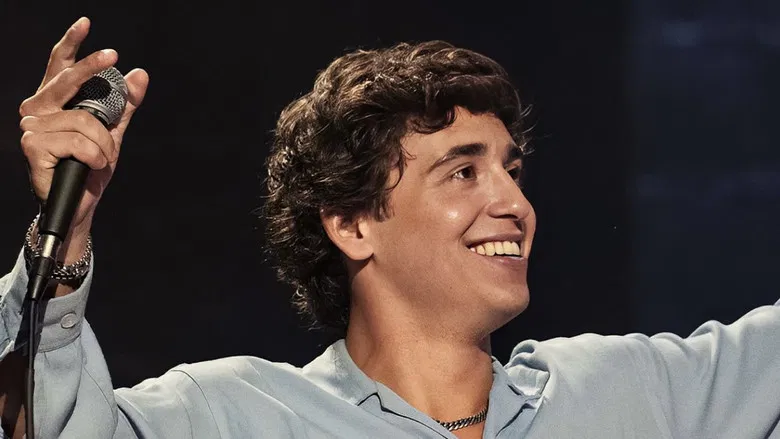
The Pulse of the American DreamIn the modern landscape of comedy, where irony often serves as a defensive shield, Marcello Hernández steps onto the stage of Miami’s Olympia Theater with the terrifying, unbridled sincerity of a golden retriever who has just learned to speak Spanish. His debut Netflix special, *Marcello Hernández: American Boy*, directed by Nicholaus Goossen, is less a routine and more a kinetic exorcism of the immigrant experience. Filmed in his hometown, the special does not merely showcase the *Saturday Night Live* breakout star’s material; it contextualizes his frantic energy as a survival mechanism, a necessary vibration for a first-generation son trying to harmonize the static between two worlds.
Hernández’s physical presence is the first thing that demands attention. Goossen, a director who cut his teeth on the raucous, stoner-comedy energy of the mid-2000s (*Grandma’s Boy*), wisely chooses to get out of the way. He shoots Hernández not as a stationary orator but as a prizefighter in the ring. The camera struggles to keep pace with him as he stalks the perimeter of the stage, his suit absorbing the sweat of a performance that feels athletic in its intensity. This is not the dry, stool-sitting philosophizing of the old guard; this is comedy as cardio. The visual language reinforces the central thesis: for the child of a Cuban mother and a Dominican father, stillness is suspicion. To be still is to be lazy, and to be lazy is to betray the sacrifice that brought you here.
The emotional anchor of *American Boy* is, inevitably, the Mother. In lesser hands, the "Latina Mom" trope dissolves into caricature—the 𝘊𝘩𝘢𝘯𝘤𝘭𝘢, the yelling, the guilt. Hernández certainly plays the hits, but he infuses them with a specific, architectural reverence. He describes his mother not just as a disciplinarian, but as the author of his reality. The special’s standout sequence involves a bit about Child Protective Services (CPS) that serves as a masterclass in cultural dissonance. Hernández dissects how a casual school bus rumor spirals into a state investigation, contrasting the sterile, bureaucratic concern of the American system with the volatile, fierce protection of the Latino home. He argues, convincingly and hilariously, that the fear of the belt was not a trauma to be unpacked in therapy, but a form of communication—a physical language of high stakes.
This friction between the "American" aesthetic and the immigrant reality culminates in his analysis of the sitcom *Full House*. For Hernández, the Tanners weren't just a TV family; they were an alien species. He deconstructs the soft lighting and gentle parenting of 90s white America with the bewilderment of an anthropologist. It is a brilliant segment because it reframes the "normalcy" of American pop culture as the absurdity. By viewing Danny Tanner through the lens of a Miami hustler, Hernández exposes the privilege inherent in "gentle parenting"—a luxury afforded to those who don't have to fight to be understood.

Critics might argue that the special’s relentless pace can be exhausting—a "screaming goat" assault on the senses, as some detractors have noted. And yes, there are moments where the volume threatens to capsize the nuance. But to ask Hernández to lower his voice is to misunderstand the assignment. His volume is his inheritance. *American Boy* succeeds because it acknowledges that for the first-generation American, the "Dream" isn't a destination of quiet contemplation; it is a loud, sweaty, frantic grasp at validation. Hernández proves that he is not just an SNL diversity hire, but a comedian with a distinct, palpitating heart. He runs until he is breathless, terrified that if he stops, the dream might stop with him.