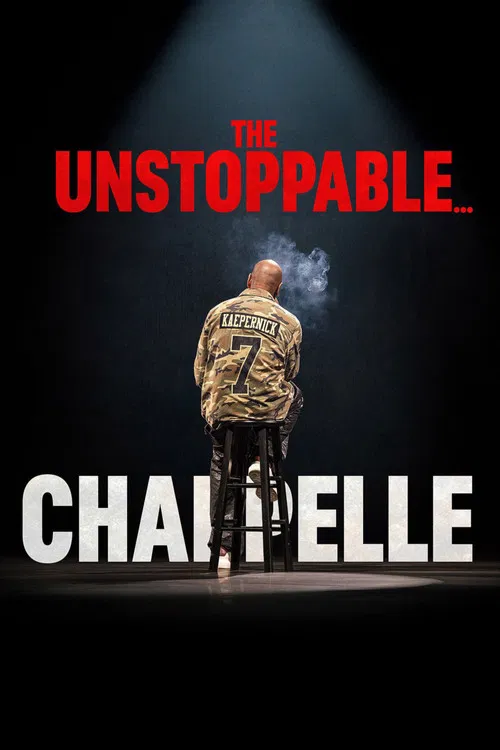
The Weight of SilenceThe modern comedy special has largely abandoned the club for the cathedral. It is no longer enough to be funny; one must be important. In *Dave Chappelle: The Unstoppable...*, directed with surgical precision by Rikki Hughes, this transition from jester to sage feels complete, for better and for worse. Filmed in his hometown of Washington, D.C., the special is less a collection of jokes than a seventy-five-minute sermon on power, paranoia, and the suffocating cost of freedom. Chappelle has long since stopped asking for our approval, but here, he seems to be testing the very limits of our patience, daring the audience to find the punchline amidst the philosophy.
Hughes frames Chappelle not as a performer but as an icon, using a visual language that emphasizes isolation. The stage is often bathed in high-contrast lighting, casting the comedian in silhouette against a sea of darkness. This aesthetic choice mirrors the special’s thematic core: the loneliness of the truth-teller (or perhaps, the martyr).

The special’s architecture is undeniably ambitious, anchoring its narrative on the historical tragedy of boxer Jack Johnson and the Mann Act. Chappelle weaves this century-old injustice into a modern tapestry involving Sean Combs and his own brush with "cancellation," suggesting a cyclical nature to how Black success is policed in America. It is a heavy, intellectual gambit that transforms the comedy set into a lecture hall. When he speaks of the "code word"—the phrase he claims he would never say unless compromised—the room falls into a silence that is electric, uncomfortable, and profoundly revealing. He is not looking for laughs here; he is looking for witnesses.
However, the narrative collapses under its own ambition when Chappelle pivots to his recent controversies. His defense of performing in Saudi Arabia and his continued fixation on the transgender community feel less like bold truth-telling and more like a refusal to evolve. The defiance that once felt revolutionary now occasionally drifts into the reactionary. The brilliance of his storytelling—specifically the "falcon story"—reminds us of his peerless command of the craft, but it sits uneasily beside grievances that feel increasingly solipsistic. He is a master at controlling the room, utilizing silence as a weapon, but one wonders if he is listening to the silence or merely basking in it.

Ultimately, *The Unstoppable...* is a fascinating, frustrating document of a legend wrestling with his own mythology. It is a performance of immense technical skill, delivered by a man who has mastered the art of speech but perhaps lost the art of conversation. Chappelle remains a singular force in American culture, a figure who demands we look at the ugly contradictions of our society. Yet, as the special ends and the applause washes over him, the lingering feeling is not joy, but exhaustion—the heavy toll of a war that only Chappelle seems to be fighting.