The Last Jester StandingIn the ecosystem of Thai entertainment, Udom "Note" Taepanich is not merely a comedian; he is a barometer of the national mood. For over three decades, his *Deaw* (Solo) specials have served as cultural milestones, documenting the shifting anxieties of Thailand's middle class with the precision of a sociologist and the timing of a jazz drummer. But *Deaw Still Alive* (2026) arrives with a different weight. Following the explosive political fallout from his previous special—where his satire of the "sufficiency economy" drew threats of legal action and cancellation—the title itself is an act of defiance. This isn't just a comedy routine; it is a statement of survival.

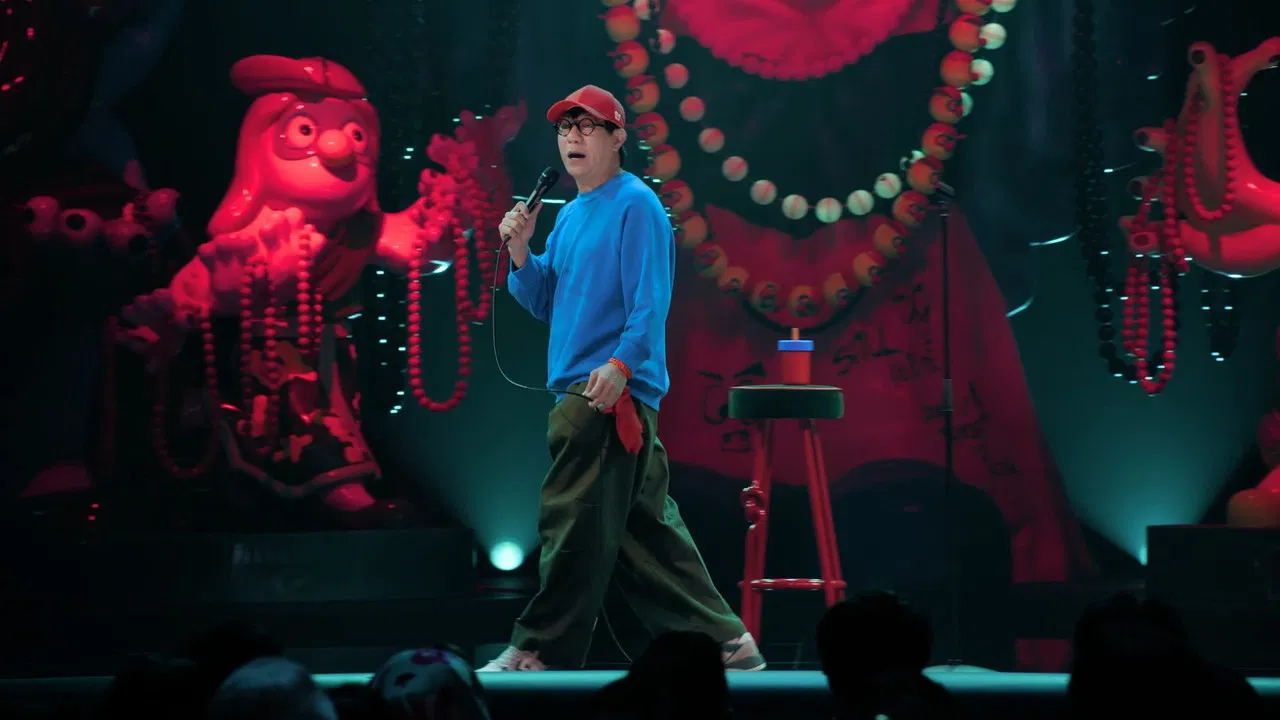
Visually, Taepanich has always understood that stand-up in an arena demands theatricality. Where his early shows were defined by prop-heavy whimsy, *Deaw Still Alive* strips back the artifice to focus on the man himself. The stage design is deceptively simple, often isolating him in pools of stark light that emphasize his aging features. It is a visual admission of vulnerability. He is no longer the frantic youth in a chaotic costume; he is an elder statesman of humor, standing alone against the void. This minimalist approach forces the audience to lean in, turning a cavernous hall into an intimate confessional.
The narrative architecture of the show rests on two pillars: the absurdity of superstition ("Mutelu") and the alienation of foreign travel. The segment regarding his time in Korea is particularly sharp. Rather than relying on tired stereotypes, Taepanich turns the lens inward, using his experiences in a hyper-modernized society to highlight his own feelings of obsolescence and displacement. When he speaks of "dark rituals" and superstition, he isn't just mocking Thai belief systems; he is exploring the desperation that drives people to seek control in an uncontrollable world. It is a masterclass in using the specific to illuminate the universal human condition.

However, the true heart of *Deaw Still Alive* lies in what is left unsaid. While the script dances around the direct political commentary that landed him in hot water previously, the subtext is deafening. His "chaotic life" stories serve as metaphors for a society trying to laugh while navigating a minefield of censorship and social division. He treats his own survival—both career-wise and physically—as the ultimate punchline. There is a palpable sense of melancholy beneath the laughter, a recognition that the role of the jester is dangerous when the court stops finding the jokes funny.
Ultimately, *Deaw Still Alive* proves that Udom Taepanich has lost none of his potency. He remains a virtuoso of long-form storytelling, capable of weaving disparate threads about Korean cosmetic culture and mystic rituals into a cohesive tapestry of modern Thai angst. It is a performance of resilience, proving that while the jester may be bruised, he is certainly not broken. In a world that often demands silence, Udom’s refusal to leave the stage is his most powerful joke yet.