The Geometry of JusticeLegal dramas often suffer from a peculiar kind of architectural boredom: the sterile gloss of high-rise conference rooms or the wood-paneled suffocation of the courtroom. They are spaces designed for rhetoric, not humanity. But in *Pro Bono*, a 2025 series that marks a compelling return for Jung Kyung-ho, the architecture of justice is dismantled and reassembled in the cramped, sun-starved corner office of a pro bono team. Here, the law is not a sword for the powerful, but a shield for those who have already been struck down.

Directed by Kim Seong-yoon (*Itaewon Class*) and written by former judge Moon Yoo-seok, the series operates on a frequency that is deceptively light. It begins with the spectacular fall of Kang Da-wit (Jung Kyung-ho), a star judge whose ambition is matched only by his meticulously curated social media presence. Da-wit is a man who treats the judiciary like a performance art, dubbing the Seoul Central District Court his "castle." When a bribery scandal—or rather, a misunderstanding involving family debt—exiles him to the "Pro Bono" team of a major law firm, the show establishes its central visual metaphor: the descent. Da-wit moves from the high bench, looking down on the world, to the street level, where he must look people in the eye.
Jung Kyung-ho, fresh off his role in *Labor Attorney Noh Moo-jin*, proves again why he is one of the most versatile actors working in Korean television today. He sheds the neurotic charm of his *Hospital Playlist* days for something sharper and more brittle. His Da-wit is initially insufferable—a man who views his clients (migrant workers, disabled children, victims of industrial accidents) as obstacles to his reinstatement rather than human beings. But Jung plays this arrogance with a fragile, frenetic energy that suggests a man terrified of his own irrelevance. He is perfectly counterbalanced by So Joo-yeon as Park Gi-ppeum, a "law otaku" whose sincerity acts as a foil to Da-wit’s cynicism. Their dynamic avoids the tired "bickering lovers" trope, settling instead into a respectful friction between idealism and pragmatism.
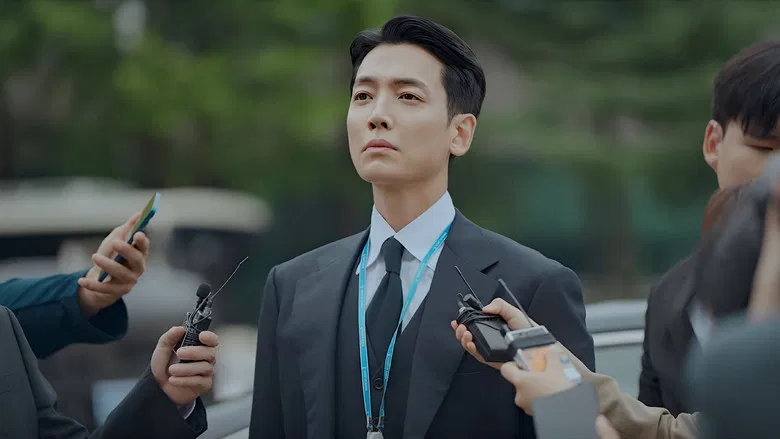
The series shines brightest when it tackles the "blind spots" of South Korean society. Unlike the glossy revenge fantasies that dominate the genre, *Pro Bono* is interested in the mundane cruelty of bureaucracy. One standout arc involves a foreign daughter-in-law facing domestic violence in rural Korea. The camera lingers not just on the bruising, but on the isolation of the landscape—the vast, empty fields that trap her as effectively as any prison cell. The show doesn't shy away from the xenophobia latent in the legal system, forcing Da-wit (and the audience) to confront the uncomfortable reality that "justice for all" often comes with an asterisk.
However, the series is not without its tonal wobbles. At times, the script leans too heavily on comedic sound effects or slapstick to soften the blow of its heavier themes, a common habit in K-dramas that fears alienating a casual audience. The transition from a harrowing suicide attempt to a lighthearted team dinner can feel jarring, a narrative whiplash that threatens to undermine the stakes. Yet, writer Moon Yoo-seok’s background as a judge anchors the legal arguments in a satisfying, granular realism. The victories here are not won by shouting matches, but by finding the loophole in a contract or a forgotten precedent in a dusty archive.

Ultimately, *Pro Bono* is a meditation on what it means to be "useful." Da-wit begins the series obsessed with his value as a "product"—a Supreme Court nominee, a celebrity, a winner. By the finale, he understands that his true worth lies in his ability to be used by those who have no other options. It is a quieter, humbler definition of heroism, one that doesn't require a gavel or a high bench, but simply the willingness to listen when no one else will. In a genre obsessed with winning, *Pro Bono* makes a powerful case for simply showing up.


