The Architecture of SoulsTo revisit the 2004 adaptation of *Bleach* in the modern era is to walk through a museum of early 21st-century shōnen aesthetics—a structure that is at once grand, sprawling, and occasionally in need of renovation. As one of the "Big Three" pillars that upheld the global anime boom of the mid-2000s, the series occupies a complicated legacy. It is too stylish to be dismissed as mere "action cartoons" yet too uneven to be canonized without asterisks. Directed by Noriyuki Abe and adapting Tite Kubo’s distinctively jagged manga, the series is less a story about fighting ghosts and more a visual poem about the burden of grief and the violent necessity of protecting what we love.
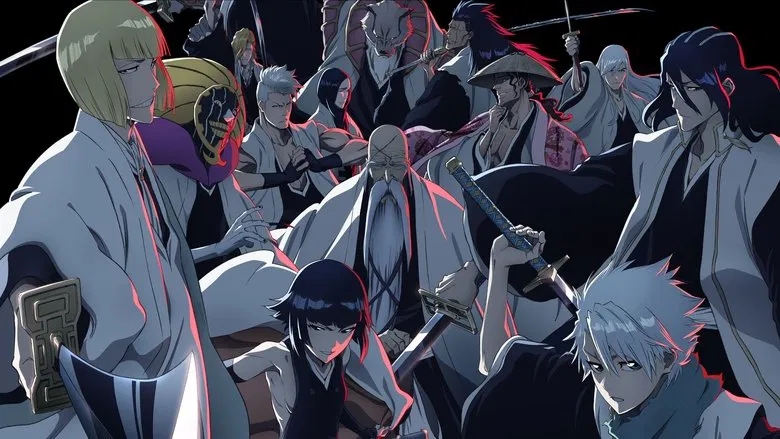
Visually, *Bleach* operates on a frequency of "cool" that few contemporaries managed to replicate. While its peers were often bright and round, *Bleach* embraced the sharp, the angular, and the urban. The series borrows heavily from the language of fashion photography and punk rock; the character designs are lanky and draped in fabric that moves with a specific, heavy physics. When spiritual pressure—*reiatsu*—is exerted, the screen doesn't just flash; it feels crushed under a gravitational weight. The animation, particularly in the earlier "Substitute Soul Reaper" arc, utilizes a stark contrast of shadows to turn the empty streets of Karakura Town into a liminal space between the mundane and the macabre. It suggests that the spiritual world isn't a distant fantasy land, but a terrifying layer superimposed directly over our own.
However, the narrative architecture is where the series faces its greatest struggle. The show is infamous for its pacing issues and the intrusion of non-canonical storylines that disrupt the emotional momentum. Yet, when the series locks into its central groove—specifically the legendary *Soul Society* arc—it achieves a kind of operatic grandeur. The invasion of the Soul Society is not merely a rescue mission; it is a clash of ideologies. We see a rigid, bureaucratic purgatory governed by ancient laws colliding with the chaotic, youthful humanism of the protagonist, Ichigo Kurosaki.

At the center of this storm is Ichigo, a protagonist who defies the genre’s typical "chosen one" trope of seeking to become the King or the Hokage. Ichigo’s motivation is painfully, beautifully small: he just wants to keep his friends from dying. This reluctance gives the action a desperate, reactive quality. His battles are not for glory, but for survival. The emotional core of the series is often found in the silence between sword strikes—the gaze of Rukia Kuchiki accepting her execution, or the stoic repression of Byakuya Kuchiki. These characters are defined by their internal walls, and the violence of the series is often a metaphor for breaking those walls down.

Ultimately, *Bleach* (2004) is a flawed masterpiece of style and atmosphere. It captures a specific teenage melancholy—the feeling of having power but no direction, of seeing monsters that adults refuse to acknowledge. While the recent *Thousand-Year Blood War* revival has polished the visuals to a cinematic sheen, the original series retains a raw, gritty texture that feels authentic to its time. It is a reminder that in the world of spirits, the heaviest weapon one carries is not a sword, but the resolve to endure.