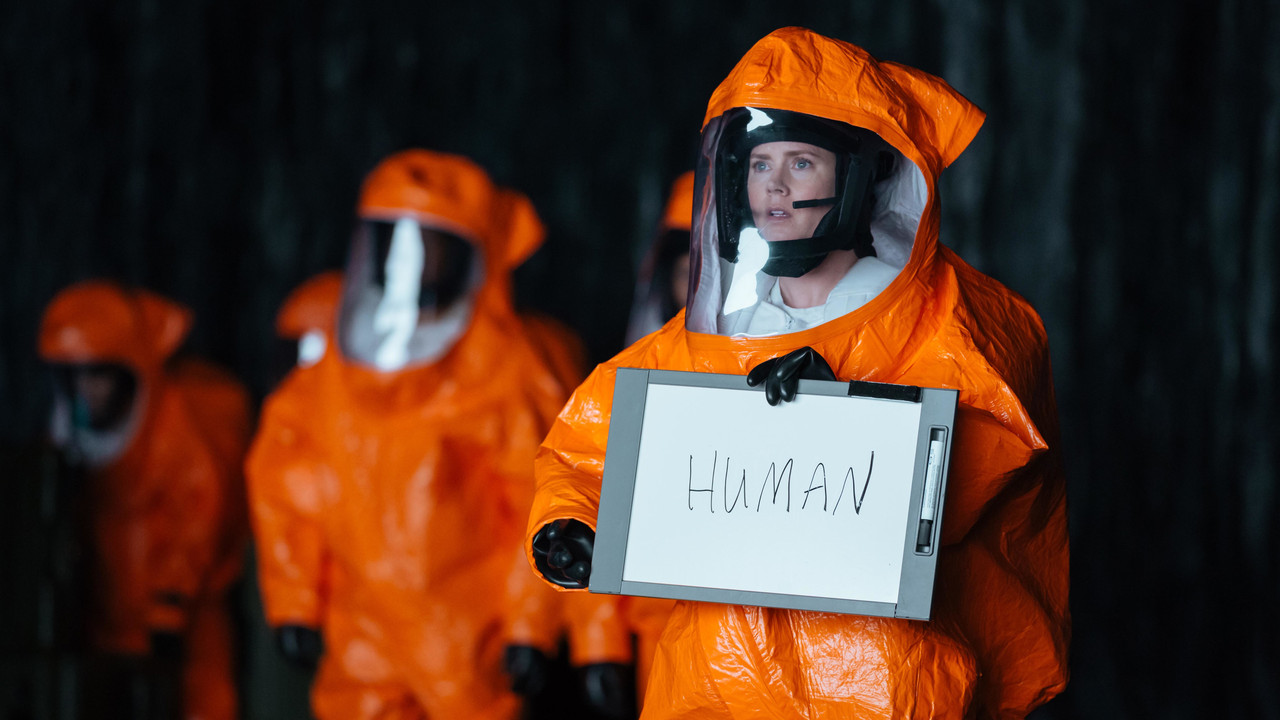
The Architecture of EmpathyScience fiction, in its most commercial form, often treats the alien as an antagonist—a jagged edge against which humanity sharpens its spear. But in Denis Villeneuve’s *Arrival* (2016), the extraterrestrial is not a conquest but a mirror. Adapted from Ted Chiang’s novella *Story of Your Life*, the film bypasses the genre’s usual pyrotechnics to construct something far more fragile: a meditation on the devastating weight of communication. Villeneuve, a director who frequently traffics in the ominous (from the sun-bleached dread of *Sicario* to the industrial gloom of *Prisoners*), here applies his brutalist aesthetic to a story that is, ultimately, about the softness of acceptance.
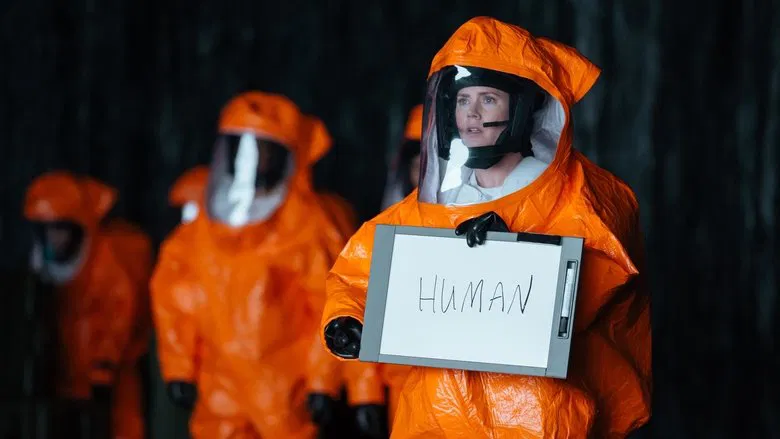
From a visual standpoint, *Arrival* is an exercise in restraint. The cinematographer Bradford Young shoots the film in a spectrum of slate grays and wet, earthy tones, grounding the fantastical elements in a tactile reality. When the alien vessels—monolithic "shells" resembling smooth, black river stones—hover over twelve locations worldwide, they do not loom with the mechanical menace of *Independence Day*. They simply hang there, silent and indifferent.
Villeneuve frames these encounters not as battles, but as varying degrees of intimacy. The central set piece—the interior of the alien ship—is a masterclass in atmospheric pressure. A rectangular glass barrier separates the humans from the "Heptapods," creating a literal screen where communication must occur. The heptapods’ language, expressed in circular, coffee-stain logograms, is visually stunning. It suggests a non-linear perception of time where beginnings and endings are irrelevant—a stark contrast to the human military's linear obsession with "first strike" and consequence.

However, the film’s true gravity comes from Amy Adams as Dr. Louise Banks. Adams delivers a performance of profound interiority, stripping away the typical bravado of a sci-fi protagonist. Her face, often shot in extreme close-up, becomes the landscape where the film’s real conflict is fought. As she learns the alien language, she isn't just decoding syntax; she is rewiring her consciousness.
The narrative brilliance lies in how it weaponizes the Kuleshov effect against the audience. We see images of a child, assuming they are memories of a tragic past—the "dead child" trope used to give a character cheap depth. But as the linguistic determinism of the plot takes hold, we realize these are not memories, but premonitions. The film’s emotional payload isn't the discovery of aliens, but the revelation of a choice: knowing life includes inevitable suffering, would you choose to live it anyway? This transforms the film from a puzzle box into a tragedy of Greek proportions, borne with quiet grace.

*Arrival* stands as a rebuttal to the cynicism of modern blockbusters. It argues that language is a technology more powerful than weaponry, capable of altering not just politics, but time itself. By the time the credits roll, the film has achieved a rare synthesis: it is intellectually demanding yet emotionally wrecking. It asks us to look at the entirety of our lives—the joy and the inevitable grief—and embrace the whole circle. In an era of loud, disposable cinema, *Arrival* demands that we sit in the silence and listen.