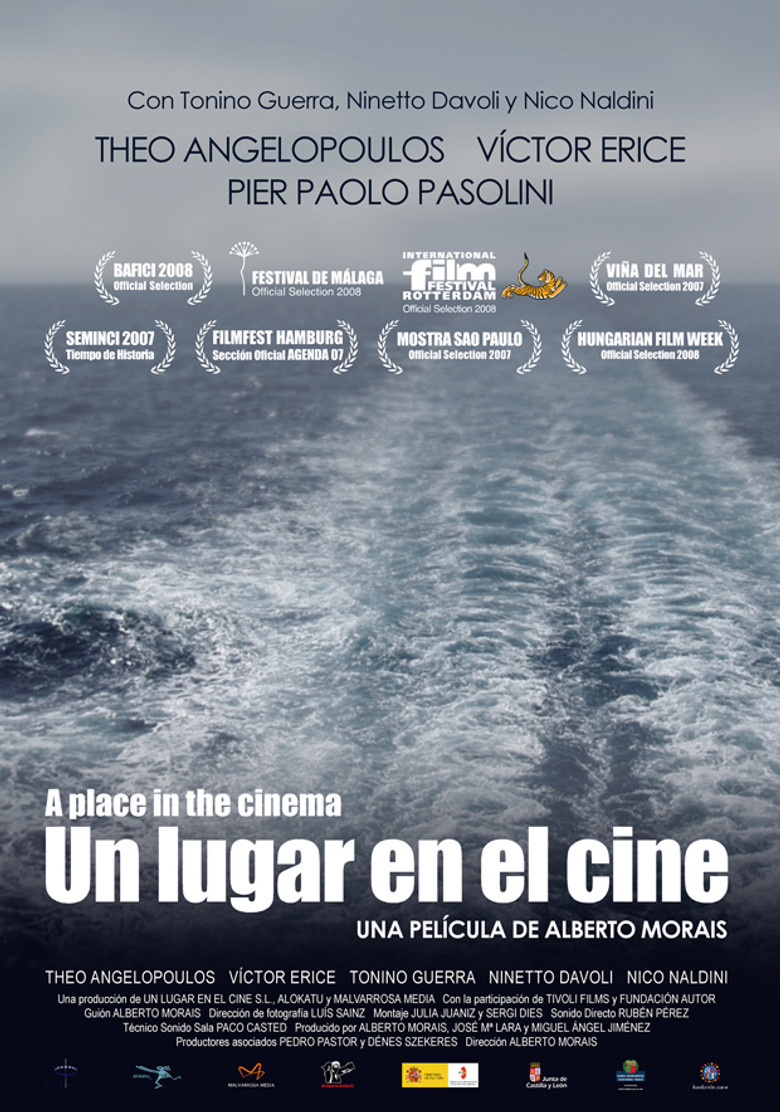
Ruins of the Future: A Requiem for ResistanceIn the modern discourse of moving images, we are often told that cinema is more alive than ever, democratized by digital tools and streaming ubiquity. Yet, there is a specific dialect of cinema—one rooted in moral weight, historical trauma, and rigorous silence—that feels increasingly like a dead language. Alberto Morais’s 2007 essay film, *Un lugar en el cine* (A Place in the Cinema), is not merely a documentary about filmmakers; it is a séance. It is a quiet, desperate attempt to commune with the ghosts of a vanishing art form, specifically the "cinema of resistance" that flourished in the wake of Neorealism. Morais does not offer us a biography of his subjects, but rather a topography of their absence.

The film constructs a fragile triangle across the Mediterranean, connecting three legendary figures who view the camera as a political and spiritual weapon: the Greek auteur Theo Angelopoulos, the Spanish recluse Víctor Erice, and the memory of the Italian radical Pier Paolo Pasolini. Morais eschews the standard "talking heads" format of television reportage. Instead, he employs a visual language that mirrors the subjects he admires. The camera is patient, often stationary, allowing the "air" of the locations to seep into the frame. When we see Angelopoulos, he is not sitting in a studio but traveling from Athens to Ostia, the desolate Roman beach where Pasolini was brutally murdered. This journey is not just physical; it is a pilgrimage to the site where a certain kind of dangerous, revolutionary cinema was violently silenced.

The emotional core of the film resides in its treatment of silence and space. In Spain, we find Víctor Erice (*The Spirit of the Beehive*) in a train station—a setting that evokes the transient nature of cinema itself, the "arrival of a train" that started it all. Erice, a director famous for his sparse output, speaks with the clarity of a philosopher-monk. He articulates the central thesis of the film: that the "resistance" of cinema is not just about opposing political dictatorships (like Franco or the Greek junta), but about resisting the erosion of humanism in a consumerist society. His words are intercut with the testimony of Pasolini’s close collaborators, Ninetto Davoli and Tonino Guerra, who conjure the murdered director’s spirit with heartbreaking joviality and sorrow. They remind us that for this generation, cinema was not a career; it was a civic duty.

*Un lugar en el cine* is demanding. It refuses to entertain in the conventional sense. It asks the audience to inhabit the pauses, to listen to the wind on the beach at Ostia, and to feel the weight of the history that these directors carried. Morais has created a work that feels less like a movie and more like a manifesto written in invisible ink. By the time the film closes, the viewer is left with a haunting question: If this "place in the cinema"—this locus of ethical engagement and poetic truth—has been abandoned, where are we supposed to go now? It is a melancholic, essential watch for anyone who believes the screen should be a mirror, not just a window.