✦ AI-generated review
The Mathematics of Sentiment
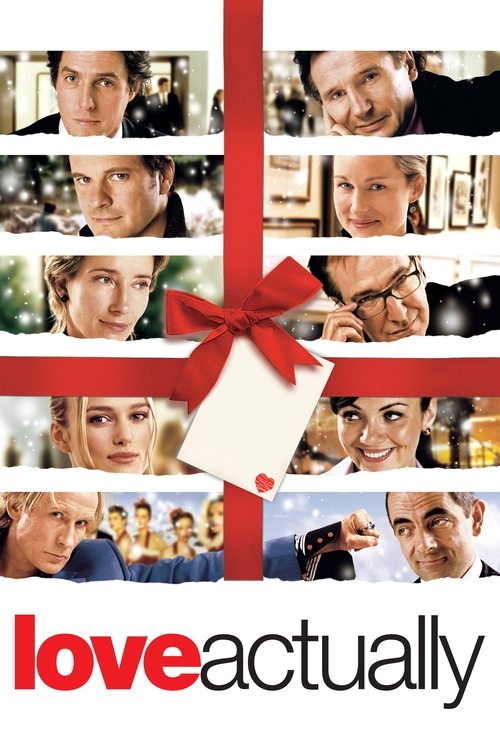
If cinema is often a reflection of how we wish the world to be, Richard Curtis’s *Love Actually* (2003) is the ultimate architectural blueprint of wish fulfillment. Released in a post-9/11 world hungry for connection—a context Curtis explicitly invokes in his opening monologue—the film posits a bold, almost defiant thesis: that love is the governing force of the human experience. Watching it two decades later, the film operates less as a coherent narrative and more as a chaotic, glossy mixtape of emotional extremes. It is a work of maximalist sentimentality that, despite its glaring flaws, manages to endure as a modern holiday canon because it dares to treat romance with the gravity of a geopolitical crisis.
Curtis, making his directorial debut after scripting hits like *Notting Hill*, utilizes a visual language that is undeniably seductive. He shoots London not as a gritty metropolis, but as a twinkling, snow-dusted storybook village where Downing Street and Heathrow Airport are stages for grand gestures. The film’s structure is its most daring gamble: a sprawling mosaic of ten intertwining storylines. By cutting rapidly between these arcs, Curtis creates a sense of breathless simultaneity. We are swept along by the editing rhythm, which suggests that at any given second, a heart is breaking in Wandsworth while another is soaring in Portugal. The sheer volume of stories forces the viewer to surrender logic and accept the film’s emotional logic: that love is a chaotic, omnipresent weather system.
However, the film’s legacy is a complicated one. Viewed through a modern lens, the cracks in Curtis’s worldview are visible. The script is frequently marred by 2003-era fat-shaming disguised as banter, and the workplace dynamics—where prime ministers and bosses romance their subordinates—often feel uncomfortable rather than charming. The infamous "cue card" scene, in which Andrew Lincoln’s character silently professes his love to his best friend's wife (Keira Knightley), has shifted in the cultural consciousness from a romantic high-water mark to a study in boundary-crossing obsession. These elements reveal a film occasionally deaf to the nuances of power and consent, prioritizing the cinematic "moment" over human reality.
Yet, *Love Actually* avoids collapsing under the weight of its own sugar content because of one crucial anchor: the storyline of Karen and Harry. While other characters enjoy airport chases and linguistic miracles, Emma Thompson (Karen) and Alan Rickman (Harry) act out a tragedy of domestic quietude. The film’s most enduring sequence is not a declaration of love, but a realization of its loss. When Karen opens a Christmas gift expecting a necklace and finds a Joni Mitchell CD instead—confirming her husband’s infidelity—Curtis holds the camera on Thompson’s face. In the privacy of her bedroom, listening to "Both Sides Now," she rearranges the bedspread and wipes her eyes. It is a devastating performance of silent fortitude that pierces the film’s glossy veneer. This scene provides the necessary "salt" to balance the film’s overwhelming sweetness, proving that Curtis understands the cost of love just as well as its rewards.
Ultimately, *Love Actually* remains a cultural juggernaut not because it is perfect, but because it is comprehensive. It catalogs love in all its permutations: unrequited, inappropriate, platonic, and familial. It functions as a collective prayer for connection, asking us to overlook its messy politics in favor of its hopeful spirit. It is a film that argues, with relentless optimism, that if you look hard enough, the world is not defined by its darkness, but by the persistent, inconvenient, and vital light of human affection.