The Architecture of NothingnessThere is a moment in the history of cinema where the "movie star" ceased to be an actor inhabiting a role and became a fixed asset, a brand to be deployed with mathematical precision. *Red Notice*, directed by Rawson Marshall Thurber, is the apotheosis of this shift. It is a film that does not ask for your attention so much as it occupies your screen, a $200 million monolith constructed not from screenplay pages, but from data points. It is less a film than a smooth, friction-free simulacrum of a blockbuster, designed to be consumed while scrolling through something else.
Thurber, who previously collaborated with Dwayne Johnson on *Central Intelligence* and *Skyscraper*, understands the assignment of the modern streaming era: create a spectacle that feels vaguely familiar, comforting in its derivativeness. The plot—a globe-trotting scavenger hunt for Cleopatra’s three golden eggs—is not a narrative engine but an excuse for location changes. We move from Rome to Bali to Russia, yet the film suffers from a distinct lack of *place*. The cinematography, polished to a digital sheen, renders every exotic locale with the same flat, illuminated texture of a high-end airport terminal.

The visual language of *Red Notice* is fascinating in its artificiality. Despite the astronomical budget, there is a suffocating sense of the "green screen" throughout. When characters stand on a balcony overlooking a jungle or a European vista, the lighting on their faces rarely matches the environment behind them. It creates a subconscious dissociation for the viewer; we are watching avatars move through a digital painting. The action sequences, particularly a daring escape from a Russian prison, function like video game cutscenes—physically impossible, weightless, and devoid of danger. There is no grit, no sweat, no sense that gravity applies to these bodies.

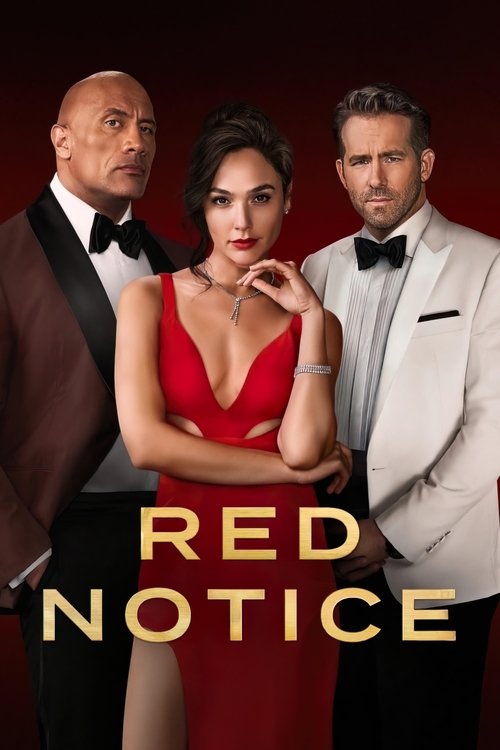
At the center of this synthetic storm are the performances, which are less about acting and more about brand management. Dwayne Johnson, playing the FBI profiler John Hartley, is once again the immovable object of stoic charisma. Ryan Reynolds, as the art thief Nolan Booth, recycles his *Deadpool* persona—a stream of ironic detachment and pop-culture references that serve to remind the audience that none of this is to be taken seriously. Gal Gadot, as the rival thief "The Bishop," glides through the film with an elegance that feels entirely detached from the chaos around her.
The tragedy here is not that the performances are poor, but that they are trapped in a feedback loop. The script does not allow them to be characters; it requires them to be "The Rock," "Ryan Reynolds," and "Gal Gadot." In the masquerade ball sequence—a scene clearly trying to evoke the sophisticated romance of *To Catch a Thief* or the tension of *True Lies*—the chemistry feels algorithmic. They banter, they dance, they fight, but there is no heat. It is a transaction between three corporations rather than a collision of three human beings.

Ultimately, *Red Notice* represents a specific kind of modern melancholy. It is a film that has conquered the metrics of viewership without piercing the cultural consciousness. It is a ghost ship of cinema—huge, expensive, and populated by the most famous people on earth, yet it sails through the mind without leaving a wake. It reflects a world where we are fed spectacle that demands nothing of us, not even our full belief in what we are seeing. It is the perfect movie for an era that has forgotten how to dream, preferring instead to simply watch.