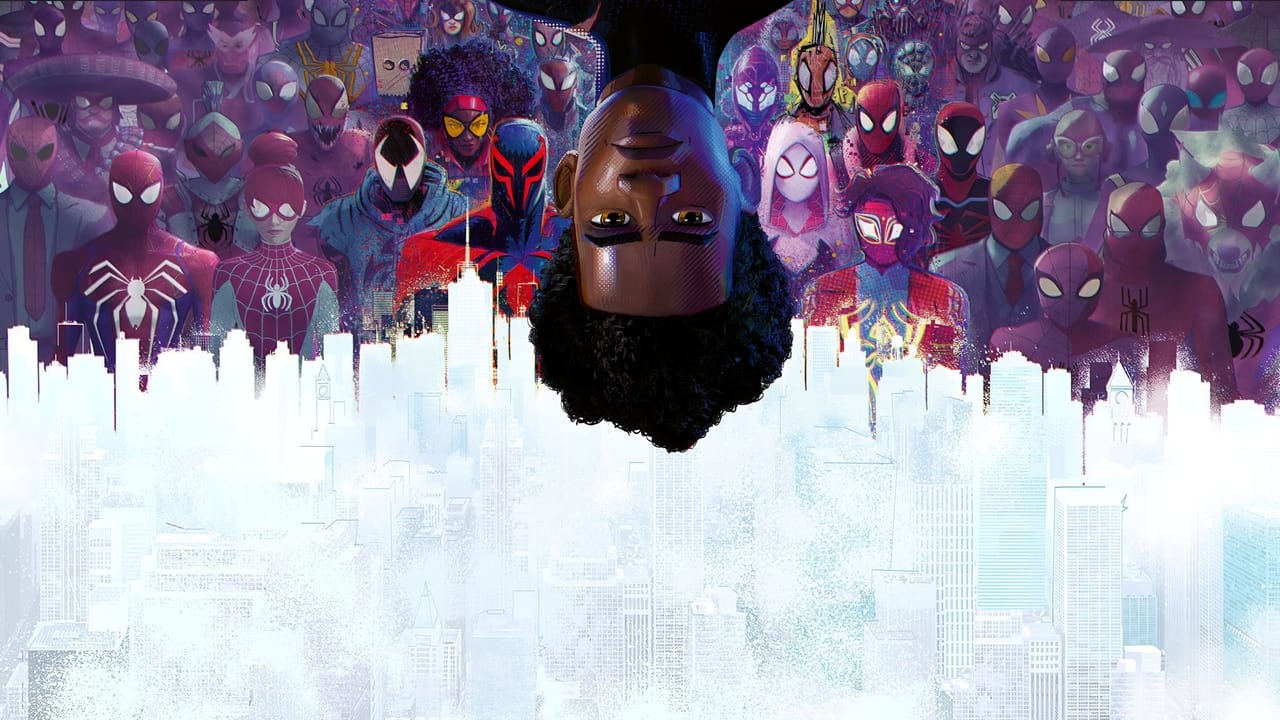
Spider-Man: Across the Spider-Verse backdrop
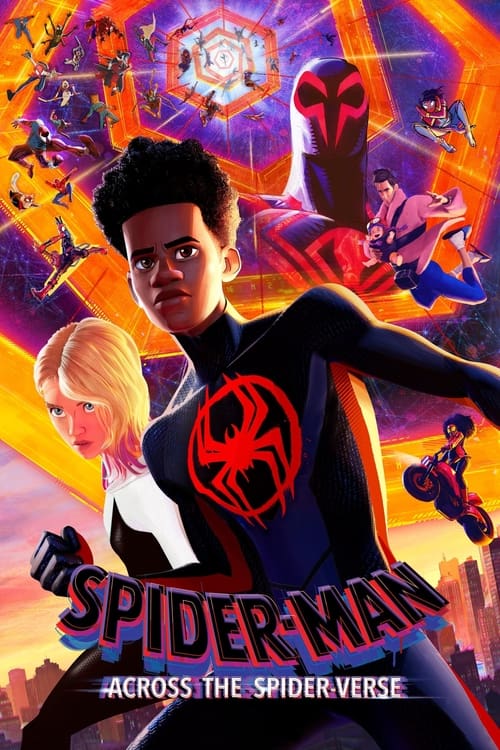
Spider-Man: Across the Spider-Verse poster

Spider-Man: Across the Spider-Verse

“It's how you wear the mask that matters.”

8.3
2023
2h 20m
AnimationActionAdventureScience Fiction
Director: Kemp Powers

Overview

After reuniting with Gwen Stacy, Brooklyn’s full-time, friendly neighborhood Spider-Man is catapulted across the Multiverse, where he encounters the Spider Society, a team of Spider-People charged with protecting the Multiverse's very existence. But when the heroes clash on how to handle a new threat, Miles finds himself pitted against the other Spiders and must set out on his own to save those he loves most.

Trailer

Trailer - "Stronger" Official

Cast

Reviews

AI-generated review
The Glitch in the Canon

In an era where the "multiverse" has become a wearying narrative crutch for studio conglomerates—a convenient mechanism to parade nostalgic cameos before a numb audience—*Spider-Man: Across the Spider-Verse* arrives not as a product, but as a manifesto. Directors Kemp Powers, Joaquim Dos Santos, and Justin K. Thompson have not merely delivered a sequel to their 2018 game-changer; they have constructed a vibrant, kinetic argument against the creative stagnation of the superhero genre itself.

If the first film was a love letter to comic books, this second chapter is a deconstruction of the mythology that binds them. The narrative collapses the distance between the medium and the message. We are introduced to the concept of "Canon Events"—immutable tragedies, like the death of a police captain or an Uncle Ben, that allegedly *must* occur to hold the Spider-Verse together. This is the film’s stroke of brilliance: it weaponizes the audience’s knowledge of superhero tropes against the protagonist. Miguel O’Hara (an imposing, vampiric Spider-Man 2099) serves as the gatekeeper of this narrative determinism, insisting that suffering is the essential ingredient of heroism.

When Miles Morales refuses to accept that his father must die for the sake of "continuity," he isn't just fighting a supervillain; he is rebelling against the algorithm of modern franchise filmmaking. The script, penned by Phil Lord, Christopher Miller, and Dave Callaham, deftly transforms a meta-textual debate about plot armor into a deeply personal story about a teenager who refuses to be a statistic in someone else’s story. "Everyone keeps telling me how my story is supposed to go," Miles says, breathless and desperate. "Nah. Imma do my own thing." It is a rejection of the fatalism that often passes for depth in blockbuster cinema.

Visually, the film is an act of anarchy. The "Pixar house style"—that safe, rounded realism that has dominated Western animation for two decades—is not just ignored here; it is obliterated. The directors treat every dimension as a distinct art installation. Gwen Stacy’s Earth-65 is a breathless mood ring of dripping watercolors, where the background bleeds from cool blues to angry reds in sync with her emotional state. In contrast, the anarchist Spider-Punk (Hobie Brown) is animated at a different frame rate, his body a chaotic collage of Xeroxed zine cutouts that literally tears through the screen's consistency. This is not eye candy; it is visual syntax. The form matches the function.

Yet, for all its psychedelic maximalism, the film is anchored by a quiet, suffocating intimacy. The most tension-filled scene is not the multiverse-spanning chase sequence, but a conversation between Miles and his mother on a Brooklyn rooftop. The animation slows down, the colors settle into the warm hues of a setting sun, and we are reminded that the stakes are not actually the collapse of the space-time continuum, but the potential severing of a family bond.

The film’s only stumble is structural; it is explicitly a "Part One," ending on a cliffhanger that leaves the emotional arc suspended in mid-air. However, unlike other recent two-parters that feel like bloated prologues, *Across the Spider-Verse* earns its pause. It leaves us gasping not because the plot is unresolved, but because the philosophy is. It challenges us to ask if we, as an audience, are complicit in the demand for our heroes' trauma. It is a dazzling, dizzying masterpiece that demands we look at the screen and see art, not just assets.

Clips (8)

Miles Listening to Music on National Record Day (Scene)

Extended Preview

Clip - Meet Jessica Drew

Hanging With Gwen

Clip - Stop Spider-Man

Clip - Gwen & Miles

Official Clip - "Missing Class"

PlayStation Exclusive Clip

Featurettes (14)

Drawn To The Moment | Joaquim Dos Santos & Justin K. Thompson

Unpacking the Multiverse

True Spider-Man Fans ft. Stan Verrett & George Kittle (ESPN)

Special Features Preview

Voice Cast Dubs Trailer

In Theaters Now

IMAX® Interview | Joaquim Dos Santos

SECRETS REVEALED! Shameik Moore, Hailee Steinfeld & Daniel Kaluuya

Pushing Past the Limits Vignette

Cast Unboxing

Spider-Center ft. Ashley Brewer & George Kittle (ESPN)

Spider-Stan ft. Stan Verrett (ESPN)

Spider-Man: Across the Spider-Verse fans in Dolby Cinema | Fan Reactions

Across the Spider-Verse cast members discuss it all | How It Happened: Across the Spider-Verse

Behind the Scenes (13)

Film Score with Daniel Pemberton - My Name Is... Miles Morales

The Film Score with Daniel Pemberton - "Start a Band"

Screenplay - Miles and Rio Promise

Screenplay - Miles and Gwen Hanging Out

Creating the Score with Daniel Pemberton

Designing Spider-Punk

Behind the Scenes with Oscar Isaac

Behind the Spider-Verse Soundtrack with Metro Boomin

Creating Pavitr Prabhakar

Issa Rae as Jessica Drew

Character Reveal: Pavitr Prabhakar

Character Reveal: Jessica Drew

Character Reveal: Spider-Punk

LN
Latest Netflix

Discover the latest movies and series available on Netflix. Updated daily with trending content.

About

  • AI Policy
  • This is a fan-made discovery platform.
  • Netflix is a registered trademark of Netflix, Inc.

© 2026 Latest Netflix. All rights reserved.