✦ AI-generated review
The Tyranny of Merriment
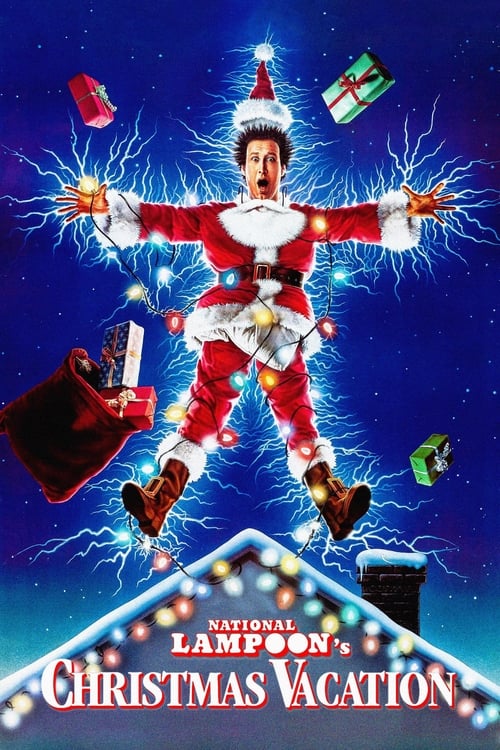
In the canon of American holiday cinema, there exists a distinct schism. On one side, we have the Capra-esque ideal, where community and spirit triumph over cynicism. On the other, we have the work of Jeremiah S. Chechik and John Hughes in *National Lampoon’s Christmas Vacation* (1989), a film that dares to suggest that the "perfect Christmas" is not a dream, but a pathology. While often dismissed as a mere slapstick vehicle for Chevy Chase, the film is, upon closer inspection, a surprisingly sharp critique of the suburban pressure to perform happiness. It is a story about a man slowly cracking under the weight of his own expectations.
Chechik, making his directorial debut, brings a glossy, commercial sheen to the Griswold household. This is no accident. The film looks like a refined advertisement for the American Dream—the snow is pristine, the wreaths are verdant, and the house is a fortress of domestic stability. Yet, Chechik uses this polished visual language to highlight the grotesque nature of Clark Griswold’s ambition. The cinematography often isolates Clark, framing him against the manic enormity of his own decorations. When Clark illuminates his home with 25,000 imported Italian twinkle lights, it is not a moment of triumph; it is a blinding, nuclear assault on the neighborhood, a visual metaphor for a man desperately screaming, "Look at how happy we are!"
At the center of this maelstrom is Clark Griswold, a character often reduced to a caricature of dad-joke incompetence. However, Chase plays him with a frantic, sweaty desperation that touches on something more tragic. Clark is not merely trying to host a party; he is trying to stop time. He is battling the encroaching cynicism of his teenage children and the judgment of his in-laws to preserve a childhood memory that perhaps never existed.
This emotional core is most visible in the film’s finest sequence: the attic scene. Accidentally trapped in the freezing crawlspace of his home while his family goes shopping, Clark discovers a reel of old home movies. For a few minutes, the slapstick noise—the falling ladders, the squirrel attacks, the bickering—vanishes. Chechik allows the camera to linger on Clark’s tear-filled eyes as he watches a grainy, silent projection of his own childhood. It is a scene of profound stillness. We realize that Clark’s manic behavior is driven by a deep, aching melancholy. He is chasing a ghost. He wants to recreate the warmth of the past, but he tries to do it through sheer force of will and excessive consumption.
The narrative structure mirrors Clark’s psychological unraveling. The film does not have a traditional plot so much as a series of escalations—the tree is too big, the relatives are too loud, the boss is too cruel. When the much-anticipated Christmas bonus is revealed to be a membership to the "Jelly of the Month Club," Clark’s subsequent meltdown is not just about money. It is the primal scream of the provider who has realized that the system he serves does not love him back.
*Christmas Vacation* endures not because it is "funny" in the traditional sense, but because it is honest. It validates the stress, the financial terror, and the familial claustrophobia that accompany the season. It suggests that the only way to survive the holidays is to let go of the picture-perfect ideal and embrace the sewage-filled chaos, quite literally, standing on the lawn in your pajamas. It is a masterpiece of anxiety, wrapped in a bow.