The Weight of Infinite IndifferenceTo call *Rick and Morty* an animated comedy is to describe a black hole as merely a "dark spot." Since its debut in 2013, the series—birthed from the chaotic minds of Dan Harmon and Justin Roiland—has mutated from a crude *Back to the Future* riff into a defining cultural text of the modern era. It is a show that doesn't just break the fourth wall; it atomizes the building, leaving its characters shivering in the cold vacuum of a godless multiverse. As the series navigates a tumultuous recent history, including the dismissal of co-creator and lead voice actor Justin Roiland, the question isn't whether the show can survive the change, but whether its central thesis—that nothing matters—can sustain itself without becoming a trap.

Visually, the series is a deceptive candy store. The animation, with its pupil-scribbled characters and neon-soaked alien vistas, invites the viewer into a Saturday morning comfort zone before violently subverting it. The directors employ a flat, clean aesthetic that makes the sudden bursts of visceral gore and cosmic horror all the more jarring. It is a universe where Cronenbergian body horror sits comfortably next to high-concept sci-fi gloss. The visual language reinforces the narrative’s core conflict: the tension between the infinite, colorful potential of the multiverse and the gray, crushing reality of Rick Sanchez’s depression. The show’s brilliance lies in how it uses these fantastical backdrops not as escapism, but as a magnifying glass for mundane human misery. A planet where the sun screams eternally is just another Tuesday for a man who cannot stand the silence of his own thoughts.

At its heart, *Rick and Morty* is a tragedy disguised as a farce. Rick Sanchez, the smartest mammal in the universe, is also its loneliest prisoner. His intelligence is a curse that strips away the comforting illusions of religion, love, and purpose, leaving him with a terrifying clarity that he tries to drown in alcohol and adrenaline. The dynamic with his grandson, Morty, has evolved from a simple victim-abuser relationship into a complex codependency. Morty is no longer just the terrified sidekick; he is the weary witness to Rick’s self-destruction, the anchor preventing the genius from drifting entirely into the abyss. The recent seasons have wisely shifted focus to the broader Smith family—Jerry, Beth, and Summer—grounding the high-concept absurdity in the messy, relatable dynamics of a dysfunction that feels painfully human. The replacement of Roiland’s voice work in Season 7 was seamless not just technically, but spiritually; the characters have grown larger than the vocal cords that birthed them.
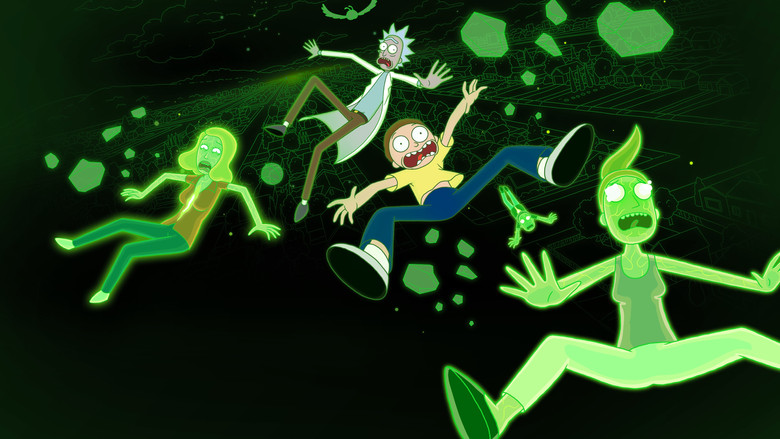
Ultimately, the show stands as a testament to the philosophy of optimistic nihilism. If the universe is infinite and nothing we do has inherent meaning, then the only meaning that exists is what we create for ourselves. *Rick and Morty* challenges us to stare into the void and laugh, not because it’s funny, but because it’s the only defiant act left. It remains a sharp, sometimes uneven, but undeniably vital exploration of what it means to be a conscious entity in an indifferent cosmos—a scream for connection echoing across infinite dimensions.