The Prismatic Shape of HopeIn the modern cinematic diet, the future is almost exclusively served cold. We have become accustomed to a menu of dystopias, where the years ahead are defined by rust, scarcity, and the gray machinery of collapse. It is a rare and startling thing, then, to witness a film that dares to weaponize optimism not as a naive retreat, but as a narrative necessity. *Arco*, the debut animated feature from French graphic novelist Ugo Bienvenu, is precisely that anomaly. It is a work that looks at the apocalypse in the rearview mirror and asks: what happens after we heal?
Bienvenu, known for his clinical yet soulful comic works like *Préférence Système*, translates his signature aesthetic—a modernization of the European *ligne claire* (clear line) style—into motion with breathtaking confidence. Unlike the hyper-realism of American studio animation, *Arco* embraces flatness as a virtue. The screen is a canvas of precise geometry and bold, unblended colors, evoking the psychedelic grandeur of Moebius and the stillness of a Renaissance fresco.

The film’s visual language is built on contrast. We begin in the 30th century, a techno-agrarian utopia where humanity lives in floating arboretums, having left the surface to "fallow." Here, the young protagonist, Arco, dons a suit that refracts light into solid ribbons of color—a rainbow trail that serves as the film’s central visual metaphor. When Arco accidentally tumbles backward in time to 2075, the palette shifts. He lands in *our* near-future, a world suffocating under domes and isolation, where the sky is choked with the debris of a society that forgot how to look up.
This arrival brings us to the film’s emotional anchor: the friendship between Arco and Iris. Iris is a child of the 2075 isolation, raised largely by a benevolent but artificial nanny-bot named Mikki. The dynamic here inevitably recalls Spielberg’s *E.T.*, but Bienvenu is interested in something more specific than the "stranger in a strange land" trope. The friction isn't just biological; it is temporal. Arco is a visitor from a timeline where humanity succeeded. His very existence is proof to Iris—and to the audience—that the current darkness is not the end of the story.

There is a quiet devastation in the scenes where Arco tries to explain his world to Iris. He possesses an innocence that she has been denied by her era’s ecological grief. In one pivotal sequence, the sharing of knowledge isn't about technology, but nature—mimicking birdsong, a skill that feels like magic in a silent world. The animation in these moments slows down, allowing the "acting" of the characters to take center stage. Bienvenu understands that the most spectacular special effect is empathy.
The narrative does flirt with conspiracy thrillers, introducing a trio of eccentric antagonists who suspect Arco’s origin, but the film refuses to let the plot overpower the poetry. The stakes remain intimately tethered to the children's bond. The tension isn't just whether Arco will get home, but whether his memory will survive in Iris, planting the seeds of the utopia he comes from.
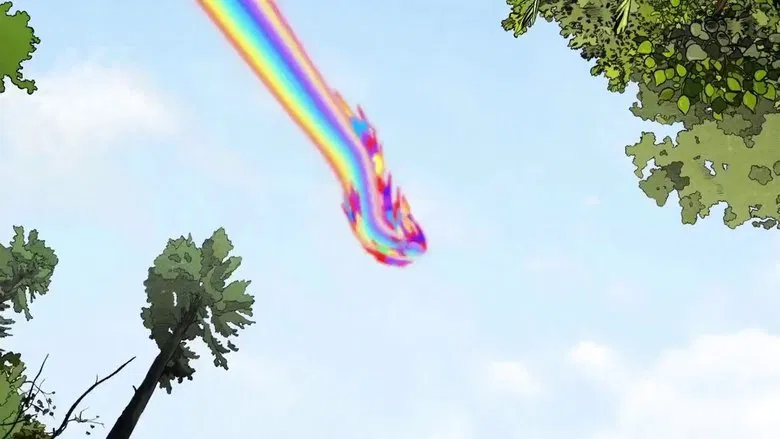
Ultimately, *Arco* is a triumph of perspective. In an era where "adult" animation often equates to cynicism, Bienvenu offers a sophisticated innocence. It suggests that hope is a discipline, a hard-won visualization of a reality that does not yet exist. By showing us the rainbow before the storm has cleared, *Arco* doesn’t just entertain; it invites us to endure. It is a luminous, vibrating argument that the future is a place worth getting to.