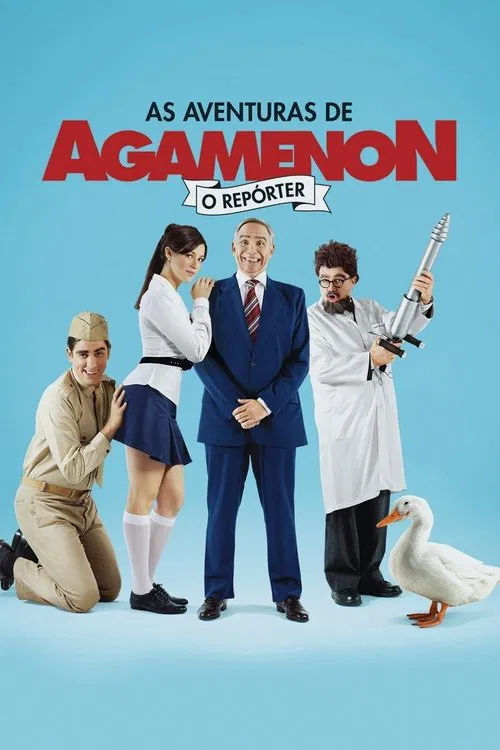
The Forrest Gump of the Tabloids: A Satire of PresenceHistory is often written by the victors, but in the peculiar logic of *Agamenon: The Film*, it is written by the bystanders—specifically, one ubiquitous, morally flexible, and profoundly clumsy reporter. Directed by Victor Lopes, this 2012 mockumentary serves as the cinematic consecration of Agamenon Mendes Pereira, a character birthed in the satirical columns of *O Globo* by the comedy troupe Casseta & Planeta. While the film positions itself as a tropical answer to Woody Allen’s *Zelig* or Robert Zemeckis’s *Forrest Gump*, it operates less as a sentimental journey through time and more as a cynical deconstruction of Brazilian journalism and the concept of "being there."

To view *Agamenon* merely as a comedy is to overlook its structural ambition. Lopes and the screenwriting team (Hubert Aranha and Marcelo Madureira) utilize the mockumentary format not just for gags, but to blur the line between archival truth and narrative fabrication. The film’s visual language relies heavily on the digital insertion of its protagonists—Marcelo Adnet as the youthful Agamenon and Hubert as the elder statesman of the newsroom—into sepia-toned footage of the 20th century. While the visual effects occasionally betray their budget, creating a jarring dissonance against the grain of actual history, this artificiality works in the film’s favor. It reinforces the central thesis: Agamenon is a fraud, a glitch in the matrix of history, a man who survives wars and catastrophes not through bravery, but through a distinctly Brazilian brand of *malandragem* (trickery).
The casting of Marcelo Adnet as the young reporter provides the film with its kinetic energy. Adnet, a chameleon of physical comedy, inhabits the role with a manic intensity that contrasts sharply with the deadpan delivery of the narrators. One of the film's most discussed sequences—and perhaps its most polarizing—involves Agamenon in World War II. Here, the film abandons historical fidelity entirely for anachronistic absurdity, as Adnet performs the "Funk dos Aliados."

It is a scene that encapsulates the movie's chaotic spirit: a collision of 1940s aesthetics with the thumping bass of modern Rio funk, suggesting that cultural identity is inescapable, even in the trenches of Europe. Yet, beneath the musical numbers and the bathroom humor (the Einstein interview being a notable low point of scatological gag), there is a persistent critique of the media itself. Agamenon is driven by an eternal love for Isaura (Luana Piovani), but he is equally driven by the hunger for a scoop, regardless of its veracity.
Ultimately, *Agamenon: The Film* functions as a farewell letter to a specific era of Brazilian humor. It bridges the anarchic, textual wit of the printed column with the visual gag reflex of television sketch comedy. While it may not reach the poignant heights of the films it parodies—lacking the emotional resonance of *Gump* or the psychological depth of *Zelig*—it succeeds as a cultural artifact. It captures a moment when Brazilian cinema felt confident enough to laugh at its own history, inserting a bumbling anti-hero into the frame and daring the audience to spot the difference between the news we are fed and the farce we are living.

In the end, Agamenon remains a cipher—a witness who sees everything but understands nothing, a metaphor for a society inundated with information but starved for meaning.