The Invoice for HeroismIn the contemporary superhero pantheon, power is usually treated as a burden of the soul or a biological destiny. The cost is existential—a lost normal life, a tragic origin story, or the weight of the world. But Lee Chang-min’s *Cashero* (2025) dares to literalize the metaphor of "paying the price" in the most mundane, anxiety-inducing way possible: cold, hard cash. Adapted from the Kakao webtoon, this series arrives on Netflix not as another CGI spectacle of city-leveling destruction, but as a grimly funny, often uneven satire on late-stage capitalism where heroism is a luxury item that the working class quite literally cannot afford.
The premise is deceptively simple and wildly effective as a social hook. Kang Sang-ung (played with endearing, frantic energy by Lee Jun-ho) is a civil servant scraping by, dreaming of buying a home in a brutal housing market. When he inherits a genetic super-strength, it comes with a cruel caveat: his physical power is directly proportional to the cash in his pocket, and using that power drains his wallet. Every punch thrown is a month’s rent vanishing into thin air; a heroic leap is a down payment dissolving into mist.

Director Lee Chang-min, whose previous work like *Welcome to Waikiki* demonstrated a flair for slapstick, utilizes a visual language here that oscillates between the fantastical and the depressingly bureaucratic. The special effects are deliberately grounded; when Sang-ung fights, we don't just see energy blasts. We see coins—the physical debris of his solvency—raining down around him. It is a visual motif that is less "cool" than it is stressful, effectively transferring the protagonist's financial panic directly to the audience. We aren’t cheering for him to defeat the villain; we are terrified he’s going to overdraft his bank account.
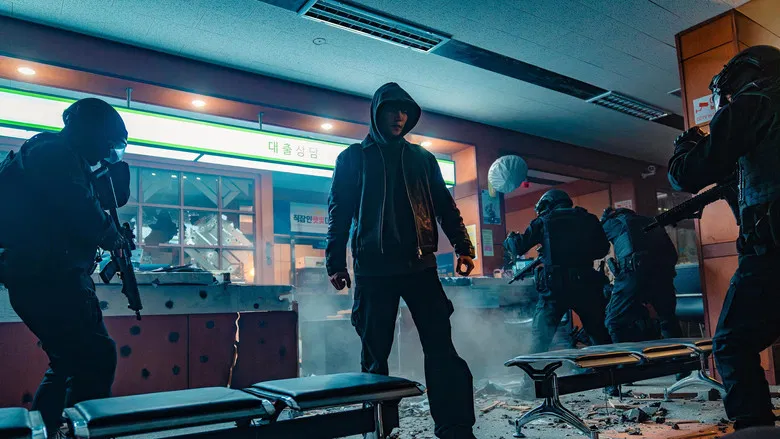
However, the series struggles to maintain the sharpness of this satire. While the "pay-to-win" mechanic is a brilliant critique of a world where money equals agency, *Cashero* often dilutes its own acid. The narrative rhythm suffers from a repetitive cycle—earn money, fight bad guy, lose money, lament poverty—that mimics the drudgery of the gig economy a little too faithfully. The show wants to be a lighthearted ensemble comedy and a gritty crime thriller simultaneously, and the seams frequently show. The villains, members of a criminal syndicate hunting "supers," feel like refugees from a more generic action series, lacking the nuance of the heroes whose powers are all hilariously conditional (one powered by alcohol, another by calories).
Yet, the show finds its soul in its quietest moments, particularly in the relationship between Sang-ung and his girlfriend, Min-suk (Kim Hye-jun). She serves as the narrative’s anchor, the calculator-wielding pragmatist who views his heroism not as a noble calling, but as a leak in their household budget. Their conflict is not about saving the world, but about the terrifying instability of modern life. Lee Jun-ho delivers a performance that is less about physical bravado and more about the exhaustion of the "working poor." His heroism is an act of financial self-immolation, making his sacrifices feel incredibly heavy.

Ultimately, *Cashero* is a fascinating, if imperfect, artifact of 2025. It strips away the mythic grandeur of the superhero to reveal the economic anxiety underneath. It posits that in a society obsessed with accumulation, the ultimate act of rebellion is to spend everything you have on someone else. It may not revolutionize the genre, but it offers a receipt for the transaction, reminding us that being a hero in this economy is the most expensive job of all.