Echoes in the StaticIn an era of hyper-visibility, where identity is often curated through filtered images and viral clips, the act of simply *listening* has become a lost intimacy. We are a culture obsessed with being seen, yet we starve to be heard. "Tune In to the Midnight Heart" (2026), the new anime adaptation of Masakuni Igarashi’s manga, taps into this specific modern ache. While on its surface it presents as a high-energy romantic comedy—complete with the requisite misunderstandings and high school archetypes—its resonant frequency is surprisingly melancholic. It asks a question that haunts the digital age: Can you fall in love with a soul based solely on the frequency of their voice?
Director Masayuki Takahashi, working with Studio Gekkou, understands that for this story to work, the audio landscape must be as vivid as the animation. The protagonist, Arisu Yamabuki, is a boy defined by his insomnia and his isolation. His only solace is "Apollo," a mysterious radio host whose voice once pierced the fog of his lonely nights. When Arisu joins the broadcasting club to find her, he isn't just looking for a girl; he is hunting for a ghost that once made him feel real.

The immediate comparison many critics will reach for is *The Quintessential Quintuplets*, given the "mystery bride" structure overlaying a group of distinct heroines. However, that comparison does a disservice to the specific texture of this series. Where other harem anime treat their heroines as prizes to be won, "Tune In to the Midnight Heart" treats them as artists in training. Rikka, Nene, Iko, and Shinobu are not merely waiting to be romanced; they are desperate to vocalize their existence.
Whether it is the aspiration to be a singer, a voice actress, or a newscaster, the narrative treats the female voice not as a fetish object, but as an instrument of professional ambition. The series shines brightest when it steps away from the "Who is Apollo?" mystery and focuses on the technical anxieties of performance. There is a palpable tension in the recording booth scenes—a suffocation that Studio Gekkou renders with tight framing and claustrophobic lighting—that captures the terror of speaking into a void and hoping someone, anyone, talks back.

Visually, the series balances the softness of slice-of-life aesthetics with a sharper, more deliberate character design that emphasizes expression over fan service. But the true special effect here is the casting. In a show explicitly about the nuances of vocal performance, the voice actresses (including standout performances by Miku Ito and Rumi Okubo) are tasked with a meta-challenge: playing characters who are learning how to act. The layers of performance—an actor playing a character who is *playing* a persona—add a dizzying, delightful complexity to the drama.
Ultimately, "Tune In to the Midnight Heart" succeeds because it validates the teenage desire to be understood without being perceived. Arisu’s search for Apollo is a metaphor for our collective search for connection in the dark. It is a gentle, often hilarious, reminder that before we can find our people, we must first find our own voice.
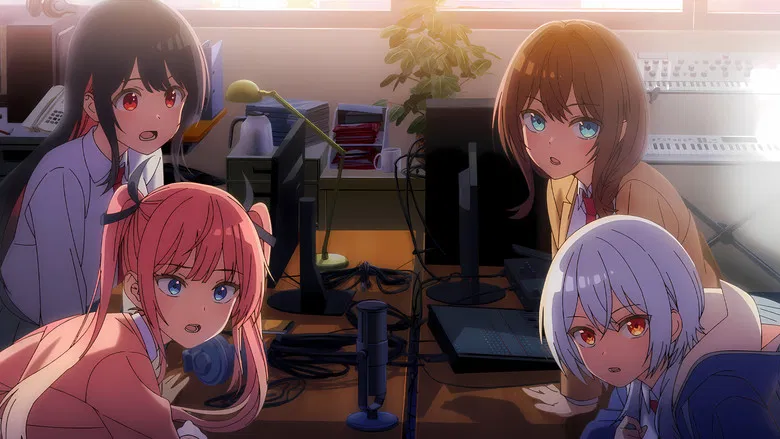
While it occasionally stumbles into the frantic pacing typical of its genre, the series possesses a sincerity that is rare. It suggests that love is not about the grand gesture or the perfect visual match, but about the quiet, shared frequency between two people who are awake when the rest of the world is asleep.