The Masquerade of Survival: Nostalgia and Justice in 1997There is a particular, bittersweet texture to the late 1990s in South Korean cultural memory—a twilight era balanced precariously between the analog warmth of the past and the cold, digital crash of the impending IMF financial crisis. In *Undercover Miss Hong*, director Park Seon-ho—celebrated for the kinetic energy of *Business Proposal*—returns to this volatile landscape not with a dirge, but with a vibrant, chaotic caper. It is a work that risks trivializing history for the sake of comedy, yet somehow manages to extract a profound narrative about dignity and identity from the fluorescent-lit purgatory of a securities firm.

The premise creates a delicious friction between status and survival. Hong Geum-bo (Park Shin-hye), a steely, elite supervisor at the Financial Supervisory Service, is forced to shed her armor of authority to infiltrate Hanmin Securities. Stripped of her credentials and her age, she becomes "Miss Hong," a twenty-year-old high school graduate making coffee and running errands. Park Seon-ho’s lens captures this transition with a frantic, rhythmic precision. The camera moves through the smoke-filled offices and cluttered desks of 1997 with a restless energy that mirrors the market’s own volatility. We are not merely watching a workplace; we are observing a caste system in freefall, where the "elite" are often morally bankrupt and the "grunt workers" hold the moral center.
Park Shin-hye’s performance is the engine that drives this mechanism. The choice to name her character "Hong Geum-bo"—a homophone for the legendary martial artist Sammo Hung—is an early signal that the director intends to subvert the delicate heroine trope. Park navigates the duality of her role with a physical comedy that feels both desperate and precise. As the supervisor, she is rigid, a woman carved from ice; as the undercover intern, she is fluid, manic, and scrappy. It is in the quiet moments of humiliation—where the "Miss Hong" persona must swallow the pride of the elite Hong Geum-bo—that the series finds its emotional truth. She is not just undercover; she is experiencing the invisibility of the working class she once regulated from above.

The series also succeeds in its spatial storytelling, particularly in the contrast between the cold, masculine battlefield of the securities firm and the warm, cramped solidarity of the female workers' dormitory, Room 301. Here, the scriptwriter Moon Hyun-kyung (known for the politically sharp *Into The Ring*) injects a necessary dose of humanity. The relationships between the women—hidden agendas notwithstanding—form a protective layer against a society that views them as disposable "assets." The romance with Go Kyung-pyo’s Sin Jeong-woo, a CEO who believes only in the honesty of numbers, avoids the trap of simple melodrama. Instead, it plays as a collision of two people trying to find a constant variable in an equation that is about to collapse.
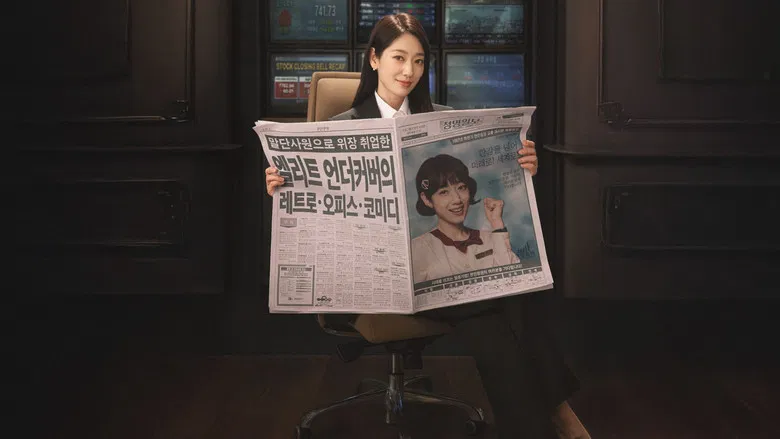
Ultimately, *Undercover Miss Hong* is more than a retro pastiche. While it delights in the aesthetic markers of the era—the pagers, the oversized suits, the frantic landline calls—it uses them to interrogate the present. By looking back at the moment before the economic bubble burst, the series asks us to consider what we sacrifice for success. It suggests that true resilience isn't found in the ledgers of a corrupt corporation, but in the ability to endure humiliation without losing one's self. In a genre often crowded with shallow nostalgia, Park Seon-ho has delivered a series that laughs in the face of disaster, reminding us that sometimes, the only way to survive the crash is to put on a mask and get to work.