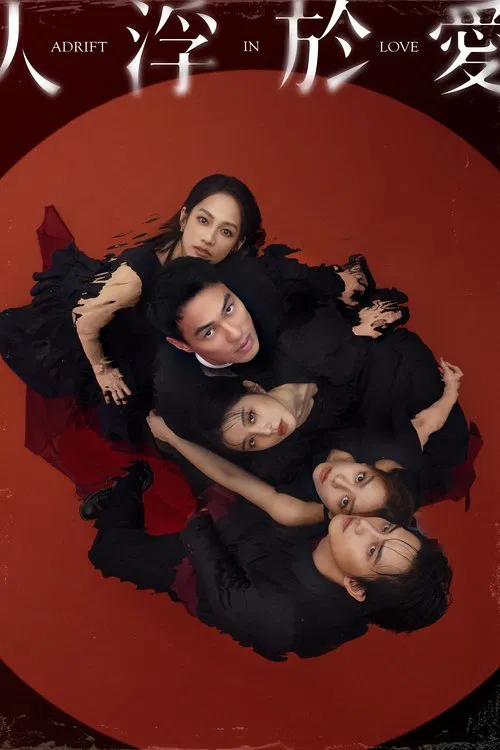
The Architecture of DesireIf modern romance is often portrayed as a collision of stars, *Adrift in Love* suggests something far more terrestrial and terrifying: a collision of debts. Adapted from Hou Wen-yong’s incisive novel, director Hsu Fu-chun’s latest series eschews the glossy escapism typical of Taiwanese idol dramas for a surgical examination of transactional intimacy. This is not a story about finding "the one"; it is a study of what we are willing to sell—our dignity, our sanity, our future—to purchase a fleeting sense of security.
Hsu, a director who previously dissected marital infidelity with clinical precision in *The Fierce Wife*, here expands his scope to the sociology of longing. The series operates on a dual track, following Zhou Xiao Qi (Ivy Shao), a woman who treats affection as a financial asset, and Pan Xin Tong (Vivian Sung), an idealist whose romantic naivety is systematically dismantled by reality.

Visually, *Adrift in Love* is suffocatingly elegant. The cinematography favors tight frames and shallow depth of field, isolating characters in their own psychological silos even when they are sharing a bed. The lighting is often cool and clinical, particularly in the scenes involving psychiatrist Gu Hou Ze (Tony Yang). These sequences, where Xiao Qi’s counseling sessions blur the line between patient and lover, are filmed with an uncomfortable intimacy. Hsu weaponizes silence here; the pauses between lines of dialogue feel heavy with unsaid recriminations. It creates a viewing experience that is voyeuristic, forcing us to witness the dismantling of professional ethics and personal boundaries.
The heart of the series lies in its refusal to villanize its "immoral" characters. Ivy Shao delivers a career-defining performance as Xiao Qi. It would have been easy to play her as a gold-digging caricature, but Shao imbues her with a tragic pragmatism. She views love through the lens of survival because her world has never offered her a currency more stable than money. Her foil, Vivian Sung’s Xin Tong, offers a different kind of tragedy: the exhaustion of the "good" woman. Her relationship with the wealthy but shadowed Xin Yi Fu (Fandy Fan) deconstructs the Cinderella trope, revealing the anxiety that comes with class ascension.

The series reaches its narrative zenith in the interactions between the psychiatrist Gu and his partner, Fan Yue Jiao (Jian Man-shu). Their relationship is a masterclass in codependency, described by critics as a "horror movie of the heart." The cliffside confrontation in the later episodes stands out not for its melodrama, but for its quiet devastation—a moment where the characters realize that their mutual destruction is the only thing binding them together.
Ultimately, *Adrift in Love* is a critique of the modern void. It argues that in a society obsessed with status and material gain, love becomes just another commodity subject to inflation and market crashes. It is a bleak, often difficult watch that denies the audience the catharsis of a happy ending, opting instead for a resolution that feels messy and undeniably human. Hsu Fu-chun has crafted a mirror for a generation that is adrift not just in love, but in life itself.