The Alien in the MirrorIt is a curious paradox of American cinema that its most commercially successful fable is also its most intimately fragile. When *E.T. the Extra-Terrestrial* premiered in 1982, it did not merely shatter box office records; it reshaped the emotional landscape of the summer blockbuster. Until then, the alien was largely a Cold War metaphor—an invader to be repelled. Steven Spielberg, however, looked at the stars and saw not a threat, but a mirror. This is not a film about an invasion, but about an abandonment. It is a spiritual autobiography written in the language of science fiction, where the creature from the stars serves as a desperate, glowing patch for a family torn apart by divorce.
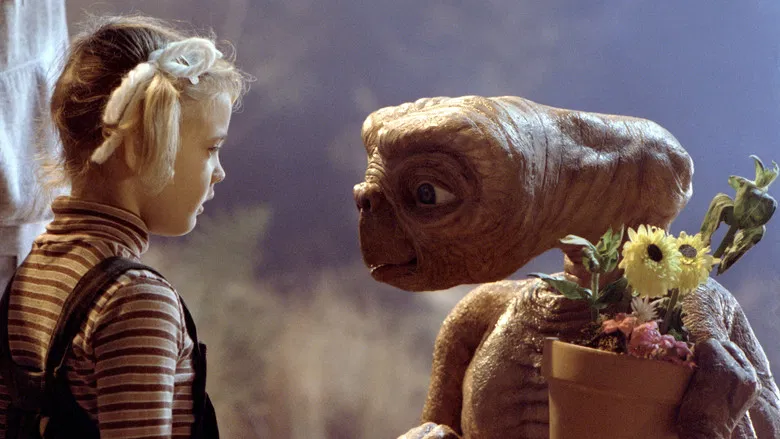
To revisit *E.T.* today is to be struck by how small it feels, despite its cosmic stakes. Spielberg’s visual strategy is rigorously disciplined: for the first two-thirds of the film, the camera rarely rises above the eye level of a ten-year-old boy. We exist in a world of knees, belt buckles, and jingling keys. The adult world is not just distant; it is faceless and menacing, a forest of flashlights cutting through the suburban fog. By locking our perspective to Elliott (Henry Thomas), Spielberg forces the audience to regress. We do not watch Elliott; we *become* him. This lowers our defenses, making us susceptible to the same loneliness that pervades the disorderly, fatherless household where the story takes root.
The genius of the narrative lies in its displacement of trauma. Elliott is a boy vibrating with the silent anger of a "middle child" lost in the shuffle of a broken home. When E.T. waddles into his life, the creature is not a pet, but a projection of Elliott's own vulnerability. E.T. is short, awkward, homesick, and unable to communicate—everything Elliott feels internally. The bond they form, the famous "empathic link," is a brilliant literalization of childhood empathy. When E.T. gets drunk, Elliott gets tipsy; when E.T. dies, a part of Elliott withers. It is a devastating metaphor for the way children process grief: they externalize it, attaching their survival to something they can physically protect because they cannot protect themselves.
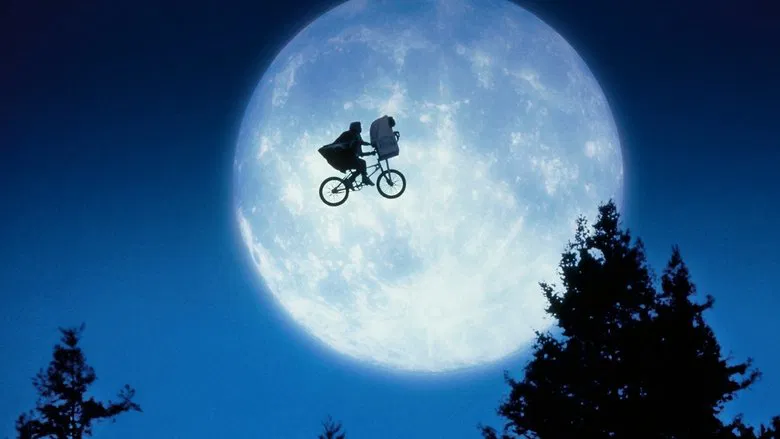
Visually, the film is a masterclass in shadow and wonder. Cinematographer Allen Daviau paints the suburbs not as the sunny paradise of 1950s sitcoms, but as a place of blue moonbeams and deep, claustrophobic closets. The famous image of the bicycle silhouetted against the moon is iconic, yes, but it is earned through the suffocating reality that precedes it. Flight is only magical because the gravity of Elliott’s life is so heavy. The special effects, grounded in Carlo Rambaldi’s tactile animatronics, provide a soulful weight that modern CGI struggles to replicate. E.T. has a physical presence; he occupies space, he breathes, and his eyes—glassy and ancient—hold a sorrow that feels uncomfortably human.
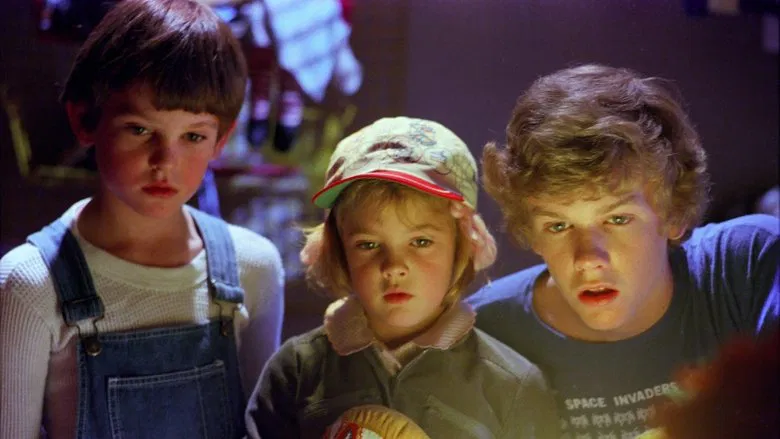
Ultimately, *E.T.* is a story about the necessity of saying goodbye. If the first half is about the fantasy of connection, the second half is a brutal lesson in letting go. The "death" of E.T. remains one of the most traumatic sequences in family film history because it strips away the fantasy. The spacesuits of the government agents turn the home into a sterile alien landscape, inverting the premise: the humans have become the terrifying extraterrestrials.
In the end, the spaceship must leave. The father figure cannot stay. The brilliance of Spielberg’s conclusion is the acceptance that love does not require presence. "I'll be right here," the creature says, pointing to Elliott's forehead. It is a resolution to the trauma of divorce that the young Spielberg suffered and the adult Spielberg corrected. The boy is still fatherless, but he is no longer broken. *E.T.* endures not because of the flying bikes, but because it admits that childhood is lonely, and then promises us that we are not alone.