Appetite for Survival in the White VoidTo label *Golden Kamuy* merely as an adventure anime is to misunderstand its ferocious appetite. At its surface, it is a treasure hunt—a Russo-Japanese War veteran and an Ainu girl searching for lost gold in the frozen wilderness of Hokkaido. But beneath the genre trappings lies a profound, often jarring meditation on what it costs to stay alive in a world that is actively trying to consume you. It is a "Western" in the truest cinematic sense, trade-swapping the scorching dust of the American frontier for the blinding white snow of Northern Japan, yet retaining the essential lawlessness where morality is measured in bullets and dried meat.

Visually, the series—adapted from Satoru Noda’s manga—walks a tightrope between the grotesque and the sublime. While the production (particularly in its 2018 debut) occasionally stumbles with jarring CGI wildlife that betrays budget constraints, the art direction shines where it matters most: in the topography of human scars. The premise involves a treasure map tattooed onto the skins of escaped convicts, a macabre puzzle that requires the characters to literally harvest human flesh to find their fortune. This body horror is rendered with a clinical detachment that makes it all the more disturbing. The camera lingers on the steam rising from open wounds just as lovingly as it does on a boiling pot of stew, creating a visual language where violence and sustenance are uncomfortably intimate neighbors.

However, the true heart of *Golden Kamuy* beats not in its gunfights, but in its cooking pot. The narrative creates a fascinating rhythm: a brutal skirmish involving bayonets and betrayal is almost always followed by a scene of the protagonist, Sugimoto "The Immortal," and his Ainu companion, Asirpa, preparing a meal. These moments are not mere comic relief; they are the show’s spiritual anchor. As Asirpa teaches the traumatized veteran how to prepare *chitatap* (minced meat) and say "Hinna" (an expression of thanks), we witness a cultural exchange that is rare in Japanese media. The series treats the indigenous Ainu culture not as a tragic relic to be pitied, but as a vibrant, pragmatic philosophy of survival that Sugimoto—a man hollowed out by modern industrial warfare—desperately needs to learn.
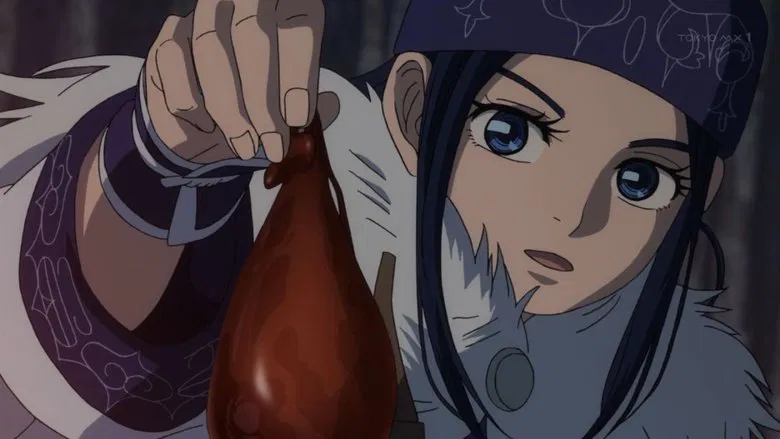
The central performance of the show is this relationship. Sugimoto acts as the embodiment of Imperial Japan’s post-war PTSD—violent, efficient, and suicidal in his recklessness. Asirpa acts as the tether to humanity, refusing to let him descend into a beast. Their dynamic avoids the tired tropes of romance or guardianship; they are partners in the business of living.
Ultimately, *Golden Kamuy* is a chaotic masterpiece of tonal dissonance. It oscillates wildy between slapstick comedy, culinary education, and visceral horror, yet it never feels incoherent. It posits that in the face of nature’s indifference and human greed, the only true victory is sitting around a fire, warm and fed, grateful for one more day of breath. It is a story that doesn't just show us the gold; it shows us the iron in the blood required to reach it.