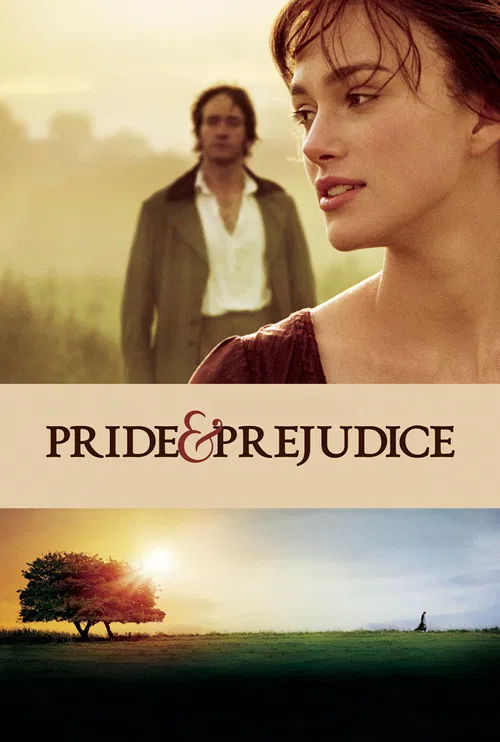
The Geometry of YearningPeriod dramas often suffer from a specific kind of suffocation: the belief that the past was a place where people stood perfectly still in pristine drawing rooms, speaking in complete paragraphs. In 2005, director Joe Wright took a sledgehammer to this vitrine with his adaptation of *Pride & Prejudice*. He did not treat Jane Austen’s text as a holy relic to be preserved in amber, but as a living, breathing organism. By trading the polished stiffness of the genre for "muddy hems" and chaotic domesticity, Wright delivered a film that feels less like a costume drama and more like a tactile memory of being young, stubborn, and terrified of love.

From the opening tracking shot, where the camera glides through the Bennet household capturing a cacophony of overlapping dialogue and unmade beds, Wright establishes a visual language of kinetic intimacy. The house at Longbourn is not a set piece; it is a crowded, noisy ecosystem where privacy is a myth and financial desperation hums in the background like a low-voltage wire. This "lived-in" aesthetic—where pigs run through the yard and the sunlight looks hazy and unwashed—ground the high stakes of the marriage market in a tangible reality. We understand, implicitly, that for the Bennet sisters, marriage is not just a romantic pursuit but a survival strategy in a world that offers them no other currency.
Wright’s most potent weapon, however, is his focus on the unspoken. While Austen is celebrated for her wit, this adaptation thrives in the silence between the words. The film’s most dissected visual motif—the close-up of Mr. Darcy’s hand flexing convulsively after he briefly touches Elizabeth into a carriage—does more to convey repressed Victorian desire than ten pages of dialogue could. It is a brilliant stroke of cinematic metonymy: a single involuntary muscle spasm betraying a man warring against his own upbringing. The camera does not just observe these characters; it stalks them, swirling around the ballroom in dizzying long takes that replicate the intoxicating, claustrophobic pressure of social scrutiny.

At the center of this whirlwind is Keira Knightley’s Elizabeth Bennet. While purists often compare her unfavorably to the serene arch-irony of the 1995 BBC adaptation, Knightley offers something arguably more vital: youth. Her Elizabeth is visibly young, prone to giggling fits, genuine hurt, and a sharp, defensive rudeness that stems from vulnerability rather than just intellect. She is matched by Matthew Macfadyen’s Darcy, who is played not merely as arrogant, but as agonizingly socially anxious—a man whose pride is a shield for his discomfort. When they meet in the rain for the film’s first disastrous proposal, the setting is not merely dramatic pathetic fallacy; it is an externalization of the violence they are doing to each other's egos.

The film’s conclusion, stripping away the social noise to leave the two protagonists alone in a misty dawn, moves the story from social satire to nearly mythic romance. While some may argue this betrays Austen’s grounded cynicism, it honors the emotional truth of the character's arc. They have navigated the geometric maze of class, wealth, and family expectation to find a clearing where they can simply exist. Wright’s *Pride & Prejudice* succeeds because it refuses to be a museum exhibit; it demands to be felt, sweating and flushing with the immediate, timeless panic of falling in love.