The Paper Cutout ProphecyIf the history of American satire were a physical landscape, *South Park* would be its strip-mined mountain range—jagged, undeniably ugly, and impossible to ignore. Since its premiere in 1997, Trey Parker and Matt Stone’s animated leviathan has evolved from a crude novelty about fart jokes into perhaps the most agile and ruthless commentary on the American condition. To view *South Park* merely as a comedy series is to miss its true function: it is a real-time responsive philosophy engine, powered by the id of a nation that has slowly lost its mind.
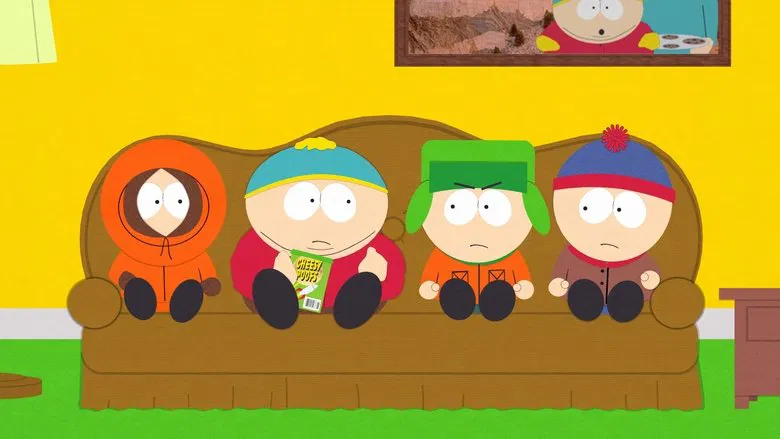
The show's visual language is its first and most deceptive trick. Parker and Stone famously began with construction paper and glue, a necessity that became a defining aesthetic. Even now, rendered in high-definition Maya software, the show mimics that original flatness. This "crappy" lo-fi style is not laziness; it is a tactical advantage. By rejecting the polished realism of Pixar or the fluid motion of Disney, *South Park* creates a Brechtian distance. The characters are not "real"—they are icons, puppets in a theater of the absurd. This visual simplicity disarms the viewer, lowering our defenses just enough for the writers to smuggle in complex dialectics about censorship, gentrification, and the commodification of outrage.

The brilliance of *South Park* lies in its production methodology, which dictates its narrative soul. Unlike *The Simpsons* or *Family Guy*, which are written months in advance, *South Park* is produced in a six-day fever dream. This immediacy allows Parker and Stone to function less like screenwriters and more like cultural first responders. When a societal shift occurs—be it a global pandemic, an election, or a celebrity meltdown—the show processes and metabolizes it before the public discourse has even settled. This speed gives the show a raw, unfinished energy that feels frantic and alive, mirroring the chaotic news cycle it satirizes.
At the heart of this chaos are the four boys—Stan, Kyle, Cartman, and Kenny—who serve as a modern commedia dell'arte troupe. Stan and Kyle often represent the bewildered rational center, the Greek chorus trying to apply logic to an illogical world. But it is Eric Cartman who stands as the show’s dark masterpiece. Cartman is not merely a bully; he is the embodiment of the American ego unchecked—narcissistic, bigoted, and terrifyingly ambitious. Through him, the show explores the terrifying potential of charisma without conscience. In recent seasons, the focus has shifted significantly toward Stan’s father, Randy Marsh, whose transformation from a background dad to a weed-farming protagonist reflects the show's aging perspective. The stupidity is no longer just childish mischief; it is now the systemic incompetence of the adults running the world.

Critics often mistake the show’s "both-sidesism" for apathy, arguing that Parker and Stone’s libertarian skepticism creates a vacuum where believing in anything is mocked. There is validity to this; the show’s "Giant Douche vs. Turd Sandwich" political philosophy can feel cynical. However, deeper observation reveals a consistent moral baseline: a hatred of hypocrisy and dogmatic certainty. The show reserves its sharpest knives not for specific political ideologies, but for the performative self-righteousness that often accompanies them. In an era of curated online personas, *South Park* remains one of the few pieces of art brave enough to suggest that everyone—regardless of their virtue signaling—is capable of being absolutely ridiculous.
Ultimately, *South Park* endures because it refuses to grow up, even as it matures. It remains a vulgar, abrasive, and often infuriating mirror. It does not promise to fix the world, nor does it offer comforting lies about human nature. Instead, it offers a cathartic scream into the void, a reminder that in a world obsessed with perfection and purity, there is something profoundly human about being made of jagged, imperfect paper cuts.